 Comparison
Best Endpoint Protection for Hotels: 2026 Review
Last Updated: October 30, 2026
Quick Summary
Endpoint protection is software that watches the front-desk computers, point-of-sale terminals, and manager laptops in a hotel for malware and suspicious behavior. For independent hotels with no IT department, a managed service that triages alerts around the clock is often the practical choice.
- Endpoint protection covers every device that connects to your network, including front-desk PCs and card terminals.
- A 2017 study of hospitality cybersecurity found weaknesses often sit in daily operations rather than headline systems.
- Ask any managed provider who responds after hours and what the response commitment is in writing.
- Segment payment devices and the property-management system from guest Wi-Fi and back-office machines.
- Cyber insurance helps cover costs after an incident but does not replace endpoint protection.
Table of Contents
- Why Independent Hotels Need Endpoint Protection
- How We Evaluated Endpoint Protection for Hotels
- Endpoint Security Software for Small Business: Top Options Reviewed
- Managed Endpoint Detection and Response for Lean Hotel Teams
- Hotel Ransomware Protection and Payment-Card Data
- Where Cyber Insurance Fits Alongside Endpoint Protection
- Choosing Your Endpoint Protection Before Your Next Review Cycle
- Frequently Asked Questions
Independent hotels are a soft target for ransomware and payment-card theft, and most of them do not have an IT department to catch an intrusion early. Best Cyber Insurance for Hotels works with hospitality operators on exactly this problem, and this guide explains what endpoint protection does, how to compare options for a property of your size, and where cyber insurance fits alongside the technical controls. This guide describes evaluation criteria and trade-offs rather than ranking products.
Why Independent Hotels Need Endpoint Protection
An endpoint is any device that connects to your network: front-desk computers, point-of-sale terminals, manager laptops, and the tablets staff use for check-in. Endpoint protection is the software that watches those devices for malware and suspicious behavior (Endpoint Protection Platform - Glossary). A 2017 qualitative study of cybersecurity in hospitality, based on case studies and interviews at five hotels, found that security weaknesses often sit in day-to-day operations rather than in headline systems (A Study of Cyber Security in Hospitality, N. Shabani).
Independent properties face a particular version of this risk. They often run a mix of property-management software, booking tools, and card terminals bought at different times, with few staff responsible for patching any of it. A single compromised front-desk machine can expose guest records and payment data.
How We Evaluated Endpoint Protection for Hotels
We judged each option against five questions an owner or general manager can actually answer:
- Device coverage: Does it protect the Windows and Mac machines, and any servers, your property runs?
- Management effort: Can a non-specialist review alerts, or does it need a security analyst?
- Response coverage: Who acts when an alert fires at 2 a.m. on a Sunday?
- Cost model: Is pricing per device, per user, or per site, and what does the quote exclude?
- Compatibility: Does it work with your property-management system and card terminals?
Where we describe products below, we rely on vendor descriptions and reported pricing, and we flag what remains unverified.
Endpoint Security Software for Small Business: Top Options Reviewed
The options below are evaluated against the devices and staffing an independent hotel property typically has, a property-management system (PMS), a point-of-sale terminal, a card reader, back-office bookkeeping, and a manager's laptop. Vendor-reported capabilities and pricing are described, and you should confirm details before signing.
How the options compare for a hotel
| Product | Model | Reported pricing | Hotel fit | What to confirm |
|---|---|---|---|---|
| Huntress Managed EDR | Managed EDR with 24/7 SOC | From $8.99 per endpoint per month | Strongest fit for lean teams that cannot triage alerts | After-hours response commitment in writing; coverage of PMS servers |
| Microsoft Defender for Business | Small-business endpoint protection | Not stated in sources reviewed | Natural fit if the property already runs Microsoft 365 | Current licensing and per-user vs. per-device terms |
| CrowdStrike Falcon | Cloud-native endpoint protection platform | Quote only | Deep detection for properties with some IT support | PMS and card-terminal compatibility; total cost at your endpoint count |
| SentinelOne Singularity Endpoint | Endpoint security with EDR | Quote only | Strong detection; needs someone to act on alerts | Whether an MDR add-on is required for 24/7 coverage |
Huntress Managed EDR
Huntress pairs endpoint detection with a staffed security operations center, so alerts are triaged by people rather than dropped into an inbox. Count every front-desk PC, back-office machine, and server when requesting a quote. Ask specifically whether the SOC will contact your property after hours and what it is authorized to do, isolate a machine, kill a process, without your approval.
Microsoft Defender for Business
If your property already pays for Microsoft 365, confirm current licensing for endpoint protection before budgeting, since bundling options may apply. Check that the plan you buy includes the endpoint detection features you expect, since Microsoft splits capabilities across tiers.
CrowdStrike Falcon
Ask vendors such as CrowdStrike Falcon for a quote, since pricing is not verified in this guide. Before committing, ask how the agent behaves on a PMS server that cannot be rebooted during business hours, and whether the vendor offers onboarding help for a property without a security analyst.
SentinelOne Singularity Endpoint
Pricing and hospitality-specific capabilities for SentinelOne Singularity Endpoint should be confirmed directly with the vendor. The practical question for a hotel is who watches it: SentinelOne can be paired with a managed detection and response provider, and that combination, not the software alone, is what gives a lean property around-the-clock coverage.
The honest trade-off
Larger platforms such as CrowdStrike and SentinelOne generally require someone who can interpret and act on alerts, while managed options such as Huntress reduce daily alert triage. For an independent hotel, a key question is who answers when an alert fires outside business hours.
Managed Endpoint Detection and Response for Lean Hotel Teams
Most independent hotels cannot staff a security operations center. A managed detection and response (MDR) service fills that gap by watching your devices continuously and escalating real threats to a person. This matters most for lean teams, where the general manager may also handle payroll and guest complaints.
Before signing, ask three things: who responds after hours, what the response commitment is in writing, and whether the service covers the specific machines your property uses. A service that sends an alert to an inbox nobody reads offers little protection.
Antivirus, Next-Generation Antivirus and EDR Compared
Traditional antivirus checks files against known malware signatures. Next-generation antivirus adds behavioral analysis, flagging software that acts suspiciously even when it is not yet catalogued. Endpoint detection and response (EDR) goes further, recording activity on each device so an analyst can trace how an intrusion started and spread.
For a hotel, plain antivirus is rarely enough. Ransomware often arrives through a phishing email or a reused password, then behaves in ways signature checks miss. EDR gives you the record needed to find out what was touched. (Source: a 2017 qualitative study of cybersecurity in hospitality)
Hotel Ransomware Protection and Payment-Card Data
Ransomware locks files and demands payment to restore them. For a hotel, the more damaging outcome is often what the attacker takes on the way in, guest names, passport and ID scans, and card data held in the PMS and payment systems, plus the operational freeze when check-in and card processing stop. Endpoint protection is one control in a chain; the sections below explain how to connect it to the devices, data, and uptime an independent property actually depends on.
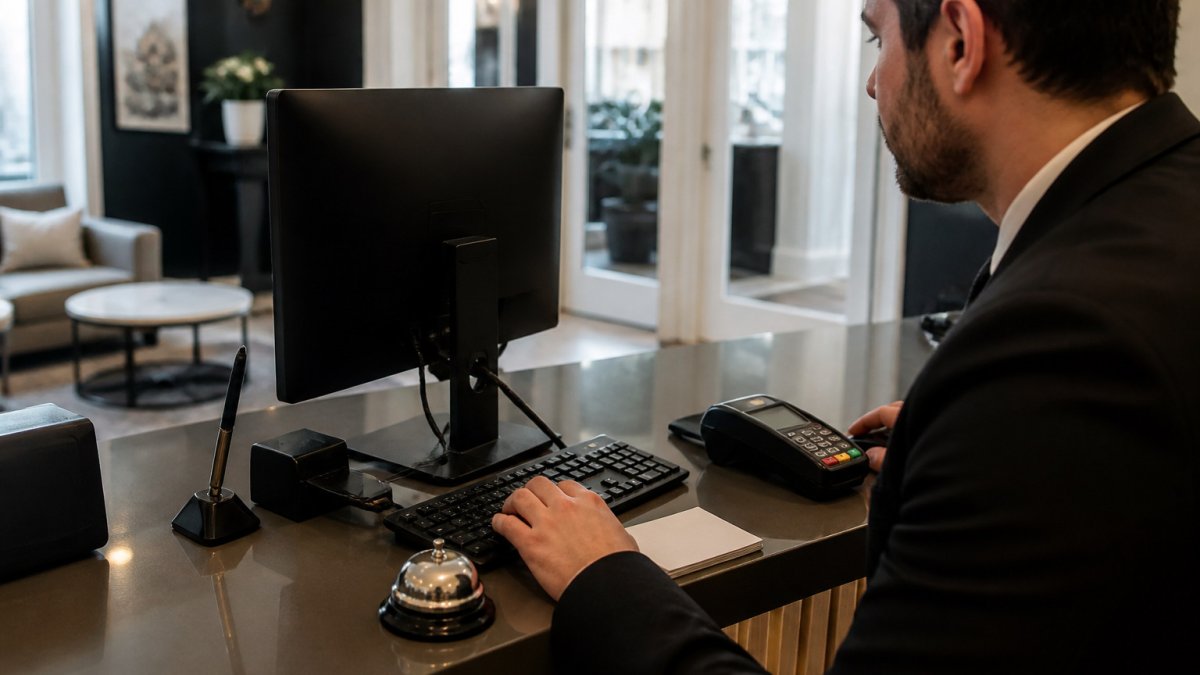
Segment the devices that touch money and guest data
A hotel network typically mixes staff computers, a PMS server, point-of-sale terminals, standalone card readers, back-office bookkeeping, and guest Wi-Fi. Treat them as zones, not one flat network:
- Payment zone: POS terminals and card readers on their own network segment, with no path to the guest Wi-Fi and limited path to the PMS.
- Guest-data zone: the PMS server and the front-desk machines that query it, restricted to staff accounts.
- Back office: bookkeeping and email, isolated from payment devices.
- Guest network: internet-only, with client isolation so guest devices cannot see each other or staff systems.
Endpoint protection supports this by letting you apply different policies per group, stricter blocking and alerting on payment and PMS devices, standard protection on back-office machines. Segmentation limits how far a single compromised front-desk PC can reach.
Connect endpoint controls to payment-card obligations
The Payment Card Industry Data Security Standard (PCI DSS) applies to properties that store, process, or transmit cardholder data. Confirm the requirements that apply to your setup with your card processor or acquirer. Endpoint software can help satisfy some of these (malware protection, logging, access restrictions), but it does not by itself make a property compliant. Confirm with your card processor or acquirer which obligations apply to your setup, and keep records: endpoint alerts, isolation actions, and patch reports are the kind of evidence an assessor or insurer may ask for. Maintaining these detailed logs reinforces the broader importance of endpoint security for smaller hospitality operations that face increasing digital threats.
Patch the systems attackers target
Most hotel ransomware arrives through a phishing email, a reused password, or an unpatched internet-facing service. Practical steps:
- Keep the PMS and card-terminal software patched, and get the vendor's update schedule in writing, many PMS vendors control patching themselves.
- Turn on automatic updates for operating systems and browsers on front-desk and back-office machines.
- Remove local administrator rights from day-to-day accounts; keep admin credentials for the few people who need them.
- Enforce multifactor authentication on email, the PMS, and any remote-access tool.
Keep backups that survive the attack
A backup stored on the same network as the machines it protects may be encrypted in the same event. Keep at least one copy offline or immutable, test a restore on a schedule, and confirm the backup covers the PMS database and not just files.
Where Cyber Insurance Fits Alongside Endpoint Protection
Endpoint protection reduces the chance of an incident. Cyber insurance addresses what happens after one. Best Cyber Insurance for Hotels offers Instant Cyber Insurance Quote tailored to the hospitality industry, with 24-hour access to a breach response team and protection against data breaches and ransomware.
Do not treat insurance as a substitute for controls. Insurers may ask about your security measures during underwriting. Before buying, check whether your existing general liability or property policy excludes cyber events.
Coverage terms vary, so ask any provider which costs are covered, which are excluded, and how the policy responds to a ransomware demand.
Choosing Your Endpoint Protection Before Your Next Review Cycle
Start with an inventory: list every device that touches guest data or payments.
Pair the technical controls with a clear incident plan that names who calls whom.
Frequently Asked Questions
What is endpoint protection for a hotel? Endpoint protection is software that monitors the computers, terminals, and tablets connected to a hotel's network for malware and suspicious activity.
Do small independent hotels need managed endpoint detection? Often, yes. A managed detection service watches devices around the clock and escalates real threats to a person, which suits properties without an internal security team.
Does cyber insurance replace endpoint protection? No. Cyber insurance helps cover costs after an incident, such as investigation and guest notification.
Frequently Asked Questions
What is the best endpoint protection for an independent hotel?
No single product fits every property. Independent hotels should compare managed detection and response, per-endpoint licensing, device coverage and how much staff time the tool requires. Vendors such as Huntress Managed EDR price per endpoint, and the final quote depends on device count and scope. Ask each vendor whether it covers front-desk workstations and payment-connected systems, and confirm the price in writing before you buy.
What endpoint security features should a hotel look for?
Look for real-time threat detection, behavioral analysis, ransomware rollback, centralized management and a security dashboard. Managed options that include 24/7 monitoring can matter more than raw detection scores for a lean team without a security operations staff. Confirm operating-system compatibility with your property-management and point-of-sale systems before deployment.
What is the difference between antivirus, EDR, and endpoint protection?
Antivirus mainly blocks known malware signatures. Endpoint detection and response (EDR) records device activity and flags suspicious behavior for investigation. Endpoint protection is the broader category that can combine antivirus, next-generation antivirus and EDR features. Many hotels benefit from a managed EDR service because someone must review alerts and respond when an incident occurs.
Does cyber insurance replace endpoint security?
No. Cyber insurance helps cover costs such as breach response, recovery and certain liabilities after an incident, but it does not stop an attack. Endpoint protection reduces the chance of infection in the first place. Most hotels need both, and insurers may ask about security controls during underwriting.