 ultimate-guide
Cost of Cyber Insurance for Hospitality: 2026 Guide
Table of Contents
- Why Cyber Insurance Hospitality Premiums Are Rising in 2026
- What Cyber Liability Insurance for Hotels Actually Covers
- Cyber Insurance Premium Factors: What Underwriters Weigh
- Data Breach Insurance Cost: Breaking Down the Numbers
- Independent Hotels vs. Franchise Properties: Different Risk Profiles
- How the Claims Process Works When a Breach Hits
- Frequently Asked Questions
Last Updated: September 15, 2026
Why Cyber Insurance Hospitality Premiums Are Rising in 2026
The cost of cyber insurance for hospitality has climbed sharply as underwriters reprice a sector they once treated as ordinary small business risk. Hotels now sit in a higher tier because they hold guest payment data, run always-on booking systems, and cannot close their doors during an incident. At Best Cyber Insurance for Hotels, we field quote requests weekly from operators who assumed their general liability policy already handled this. It does not.
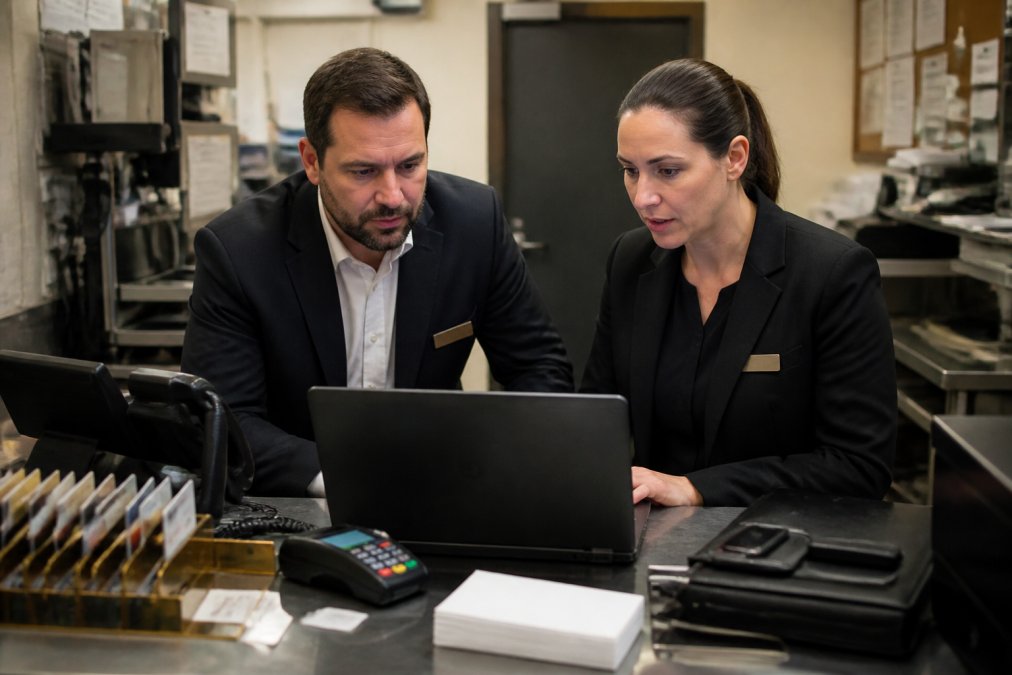
Three forces drive the increase. Ransomware crews have learned that a hotel cannot tolerate a night of downtime, so they price their demands against lost room revenue rather than the value of the stolen files (cisa.gov). Point-of-sale terminals at bars, spas, and front desks expand the attack surface well beyond the front office. And underwriting standards have tightened across the board: carriers now ask for documented security controls before they will quote at all.
The result is that hospitality accounts that once renewed quietly now face detailed questionnaires and higher retentions.
What Cyber Liability Insurance for Hotels Actually Covers
Cyber liability insurance for hotels is a policy that transfers the financial cost of a data breach, ransomware attack, or network outage from the property to the insurer. It pays for response, recovery, and legal exposure, and it typically splits into two distinct halves.
First-Party vs. Third-Party Coverage
First-party coverage pays the hotel's own costs. That includes forensic investigation, system restoration, business interruption during downtime, data exfiltration response, and in some policies, extortion payments subject to strict conditions.
Third-party coverage pays what the hotel owes others. That means legal defense costs, regulatory fines where insurable, consumer redress funds, and third-party liability claims from guests, vendors, or payment processors.
A common mistake is assuming one half covers the other. A policy that responds to a guest lawsuit may pay nothing toward restoring your property management system.
Cyber Insurance Premium Factors: What Underwriters Weigh
Underwriting for hospitality is not a flat rate. Carriers build a picture of your exposure and price against it, and the variables they weigh are predictable once you know them.
Revenue, Room Count, and Property Type
Annual premium scales with size. More rooms means more guest records, more POS terminals, and more staff with system access. Revenue matters because business interruption limits are usually set as a multiple of daily earnings, and a resort with high average daily rate carries more exposure per night of downtime than a limited-service property.
Property type also shifts the math. A full-service hotel with restaurants, a spa, and event spaces runs more payment endpoints than a select-service property of the same room count.
POS Systems, PMS Integration, and Security Controls
This is where hospitality differs from most small business risk. Your property management system holds PII (Personally Identifiable Information) for every guest, and your POS network touches card data at multiple points. Underwriters want to know how those systems connect, who can reach them, and whether card data is segmented from the general network.
PCI DSS compliance helps, but it is not a substitute for security controls. Carriers increasingly expect multi-factor authentication on administrative accounts, endpoint protection, offline backups tested on a schedule, and a written incident response plan (Cybersecurity Framework | NIST). Strong cyber hygiene lowers your premium. Weak controls raise it or remove you from the market entirely.
| Underwriting Factor | What Lowers Premium | What Raises Premium |
|---|---|---|
| Room count | Under 100 rooms | 200+ rooms, multiple outlets |
| Revenue | Stable, modest annual revenue | High ADR, event and F&B revenue |
| POS and PMS | Segmented network, tokenized payments | Flat network, stored card data |
| Security controls | MFA, tested backups, IR plan | No MFA, untested backups |
| Claims history | No prior incidents | Prior breach or ransomware event |
| Coverage limits | Lower limits, higher deductible | High limits, low deductible |
Data Breach Insurance Cost: Breaking Down the Numbers
Data breach insurance cost depends on limits and deductible, not on a published rate card. Two hotels with identical room counts can receive quotes that differ substantially because their security controls and claims histories differ. What follows is how the components fit together, and where the real money sits.
The Four Levers That Set Your Premium
- Coverage limits: the maximum the policy pays per incident. Higher limits cost more, but the jump from a $1M to a $2M limit is rarely double, carriers price the incremental layer, not the whole tower.
- Deductibles (retentions): what you pay before coverage responds. Moving from a $10,000 to a $25,000 retention is one of the fastest ways to cut annual premium, and it is the lever most hospitality operators should pull first.
- Sub-limits: caps inside the policy, often applied to ransomware or extortion payments. A $1M policy with a $250,000 ransomware sub-limit is really a $250,000 ransomware policy.
- Retroactive date: how far back the policy reaches for incidents that began before you bought it. A first-time buyer with no prior coverage has no retroactive protection, which is why carriers ask about your history.
What the Numbers Actually Look Like
Pricing is property-specific, so any figure quoted without an underwriting review is a guess. That said, the pattern most brokers and underwriters describe for hospitality accounts runs roughly like this:
| Property Profile | Typical Annual Premium Range | Typical Limit | Typical Retention |
|---|---|---|---|
| Limited-service, under 100 rooms, strong controls | Low four figures | $1M / $1M | $10,000-$25,000 |
| Select-service, 100-200 rooms, mixed F&B | Mid four figures | $1M-$2M | $25,000-$50,000 |
| Full-service with spa, events, multiple POS | Low-to-mid five figures | $2M-$5M | $50,000-$100,000 |
| Multi-property or resort portfolio | Mid five figures and up | $5M+ | $100,000+ |
These are directional, not quotes. A property with no MFA and untested backups can land above the top of its band; a property with segmented networks, tokenized payments, and a tested incident response plan can land below the bottom of it.
Why the Range Is So Wide
The spread comes from two things underwriters weigh heavily: how fast you can contain an incident, and how much revenue you lose per day of downtime.
The Costs the Policy Does Not Cover
Independent Hotels vs. Franchise Properties: Different Risk Profiles
What the Franchise Agreement Actually Requires
What Independent and Boutique Properties Face
The Coverage Structures Each Profile Needs
| Profile | Key Coverage Priority | Common Mistake |
|---|---|---|
| Franchise property | Limits that satisfy the brand mandate plus headroom for local systems | Assuming the brand's policy covers the franchisee's POS and PMS |
| Independent / boutique | Business interruption sized to peak-season revenue | Buying on premium alone and underinsuring downtime |
| Multi-property operator | Consistent limits and retentions across the portfolio | Letting each property renew on a different cycle and standard |
How the Claims Process Works When a Breach Hits
The sequence typically runs like this:
Frequently Asked Questions
How much does cyber insurance cost for small hotels?
Small hotels typically pay less than large chains because premiums scale with revenue, room count, and data volume. A 50-room boutique with limited POS transactions will see lower rates than a 300-room property with multiple restaurants and event spaces. Pricing also depends on your security controls, claims history, and coverage limits. Because every property is different, the most accurate way to find your cost is to request a quote based on your specific operations and revenue.
What factors influence the premium of cyber liability insurance?
Underwriters look at annual revenue, number of guest records processed, POS and PMS systems, existing security controls like multi-factor authentication and PCI DSS compliance, prior claims, and coverage limits. Properties with strong cyber hygiene and documented incident response plans pay less. Higher deductibles and lower limits also reduce premiums. Revenue-based pricing means a hotel with seasonal fluctuations may see rates adjusted to peak booking periods rather than average monthly income.
Is cyber insurance mandatory for hospitality businesses?
No federal law requires hotels to carry cyber insurance. However, franchise agreements, payment processor contracts, and some state data breach notification laws create indirect pressure. Many franchise brands now mandate minimum cyber coverage for franchisees. Additionally, if you accept credit cards, PCI DSS compliance is required by card networks, and a breach without insurance can leave you covering forensic investigation, legal defense costs, and regulatory fines out of pocket.
What does a standard cyber insurance policy cover for a hotel?
Most policies cover data breach response costs, ransomware extortion payments, business interruption losses, third-party liability, legal defense costs, and regulatory fines where insurable. Some include 24-hour breach response teams for forensic investigation and system restoration. Policy exclusions often apply to known vulnerabilities or failure to maintain basic security controls. Review your policy carefully, especially around POS system coverage and social engineering fraud.
Hospitality cyber risk is not shrinking, and the properties that absorb a breach without lasting damage are the ones that planned before the incident, not during it. Best Cyber Insurance for Hotels was built for this sector specifically, with instant coverage, a hospitality-only focus, and a dedicated breach response team reachable around the clock. Get started with Best Cyber Insurance for Hotels and put a response plan in place before the next attack finds your POS network.