 ultimate-guide
Cyber Insurance for Small Hotels: A 2026 Guide
Table of Contents
- What Is Cyber Insurance for Small Hotels?
- Why Small Hotels Are High-Risk Targets for Cyberattacks
- Types of Cyber Threats Hotels Face: Ransomware, Phishing, and Data Breaches
- What Cyber Insurance Covers: First-Party and Third-Party Liability
- Hotel Data Breach Liability and Regulatory Penalties Under PCI DSS
- Cyber Insurance Cost for Small Business Hotels
- Hospitality Industry Cyber Security Best Practices and Policy Selection
- How to Choose the Right Policy Limits and Coverage for Your Hotel
Last Updated: August 29, 2026
What Is Cyber Insurance for Small Hotels?
Cyber insurance for small hotels is a specialized policy protecting hospitality properties from cyberattacks, data breaches, and related incidents. Unlike general business insurance, it covers losses directly tied to digital threats: ransomware, stolen guest data, system downtime, and breach response costs.
First-party coverage pays for your recovery costs: forensic investigation, guest notification, credit monitoring, and business interruption losses. Third-party liability coverage handles guest lawsuits and regulatory fines for data protection violations.
Hotels store sensitive guest information, credit cards, passport details, home addresses, in point-of-sale systems, property management systems, and booking platforms. A single breach can expose thousands of guests and cost hundreds of thousands of dollars in recovery, legal fees, and penalties. Best Cyber Insurance for Hotels addresses this vulnerability with policies tailored to how small hotels operate: limited IT staff, multiple third-party integrations, and guest-facing payment systems.
Why Small Hotels Are High-Risk Targets for Cyberattacks
Small hotels present attractive targets for cybercriminals: they hold valuable data but lack the security infrastructure of larger chains. Your PMS stores guest payment information, your reservation platform processes credit cards, and your Wi-Fi connects to guest devices. Attackers know independent hotels typically have fewer security resources than enterprise properties, making them easier to penetrate.
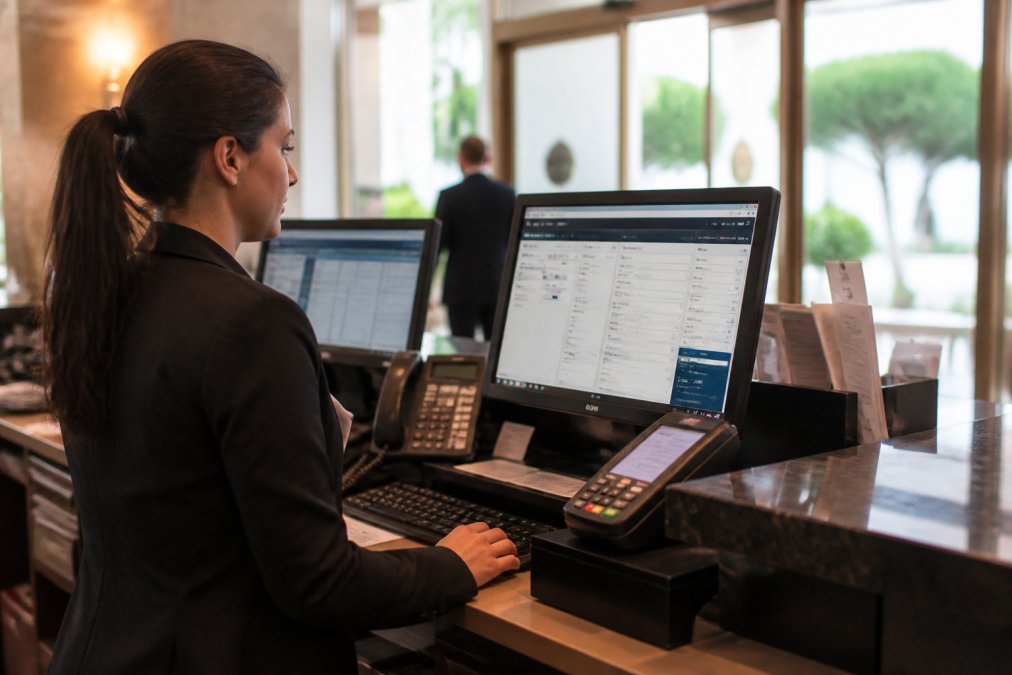
Many small hotels rely on a single IT person or outsourced support for critical systems. When phishing emails arrive or vendor systems are compromised, responses are often delayed or incomplete.
Third-party integrations compound the risk. Your hotel uses booking engines, payment processors, channel managers, and review platforms, each a potential entry point. If a channel manager's system is breached, attackers may access your guest data. This vendor risk is rarely covered by standard business insurance but is a real exposure cyber insurance must address.
Ransomware attacks are the dominant threat. Attackers encrypt your PMS, forcing you offline during peak booking periods and demanding payment to unlock systems. Cyber insurance can cover ransom negotiation and recovery costs if your policy includes ransomware coverage.
Types of Cyber Threats Hotels Face: Ransomware, Phishing, and Data Breaches
Three threat categories dominate hospitality: ransomware, phishing, and data breaches.
Ransomware encrypts your files and systems, making them inaccessible until you pay for a decryption key. An employee receives an email appearing to come from a vendor or guest, clicks a link, and malware installs silently. Within hours, your reservation system is locked. The attacker demands payment, often tens of thousands of dollars, to provide the decryption key. Cyber insurance can cover ransom negotiation, payment, and forensic investigation.
Phishing is the social engineering attack delivering ransomware and malware. Attackers send emails impersonating trusted contacts: your payment processor, PMS vendor, or a guest. Once the attacker has valid credentials or installed malware, they move laterally through your network searching for payment systems or guest databases. Phishing is the entry point for most hotel breaches. Cyber insurance covers response costs, but employee training is your first line of defense.
Data breaches occur when attackers access and steal guest information without disrupting systems. You may not notice for weeks or months. Attackers exfiltrate credit card numbers, names, addresses, or passport information and sell it on the dark web. Your guests discover the breach through unauthorized transactions. You then face notification costs, credit monitoring expenses, regulatory defense costs, and potential fines. A breach of 5,000 guest records easily costs $100,000 or more. Cyber insurance covers these first-party losses.
What Cyber Insurance Covers: First-Party and Third-Party Liability
Cyber insurance policies split coverage into two main buckets: first-party losses and third-party liability.
First-party losses are costs your business incurs directly after an incident. If ransomware shuts down your PMS, first-party coverage pays for forensic investigation, malware removal, and system restoration. If a data breach exposes guest information, first-party coverage pays for guest notification, credit monitoring, public relations management, and business interruption losses.
Third-party liability covers claims from guests whose data was compromised. If a guest's credit card is stolen in a breach and they face fraudulent charges, they may sue your hotel for negligence. Third-party coverage pays for guest legal fees, settlements, and court judgments. It also covers regulatory fines imposed by state attorneys general or the FTC for inadequate data protection.
Best Cyber Insurance for Hotels emphasizes both first-party and third-party protection because small hotels face exposure on both fronts.
Hotel Data Breach Liability and Regulatory Penalties Under PCI DSS
If your hotel processes credit card payments, which nearly all do, you're subject to PCI DSS (Payment Card Industry Data Security Standard), a set of requirements established by Visa, Mastercard, American Express, Discover, and JCB. PCI DSS mandates how you store, transmit, and protect payment card data. Failure to comply results in fines, loss of payment processing privileges, and liability for guest fraud losses.
For small hotels, the challenge is that compliance requires technical expertise many independent properties lack. Your hotel remains liable for overall security posture even if your PMS vendor handles some responsibilities.
When a data breach occurs, regulators investigate whether you met PCI DSS requirements. If you failed to encrypt payment data, failed to patch systems, or failed to restrict employee access, you're in violation. Penalties range from $5,000 to $100,000 per month depending on severity and duration. Payment card networks may also suspend your merchant account.
Beyond PCI DSS, state data protection laws add liability. Many states require breach notification and impose statutory damages per record breached. Cyber insurance covers regulatory defense costs, fines, and notification expenses.
Cyber Insurance Cost for Small Business Hotels
The cost of cyber insurance for small business hotels varies based on property size, annual revenue, guest records processed, security measures, and claims history. A 50-room independent hotel pays less than a 200-room property. Hotels with strong security practices, regular employee training, system updates, and access controls qualify for lower premiums.
Get a quote from Best Cyber Insurance for Hotels, which offers an instant quote process tailored to your property's profile. Consider that a single ransomware attack or data breach costs $100,000 to $500,000 in recovery, notification, and legal fees, making even a substantial annual premium a sound investment.
When comparing quotes, pay attention to what's covered. Some policies exclude ransomware or cap business interruption at low limits. A policy covering ransomware, data breach notification, regulatory defense, and business interruption provides much stronger protection than a basic policy.
Hospitality Industry Cyber Security Best Practices and Policy Selection
Selecting the right cyber insurance requires understanding both what coverage you need and what security practices reduce your risk. Insurance companies price policies based on your security posture, so investing in prevention lowers premiums.
Start with fundamentals. Require strong passwords (12+ characters, mixed case, numbers, symbols) for all system access. Implement multi-factor authentication on your PMS, email, and cloud-based systems. Restrict employee access to payment data: front desk staff access only check-in information; back-office staff have separate, limited access. Update all systems regularly, PMS, operating system, antivirus, and third-party applications.
Train employees on phishing and social engineering. Most breaches begin with a phishing email or impersonation call. Teach staff to verify requests before clicking links or opening attachments. Run simulated phishing tests to identify vulnerable employees.
Conduct a vendor risk assessment. Evaluate the security practices of your PMS vendor, payment processor, channel manager, and other third-party systems. Ask vendors about security certifications, incident response procedures, and breach history.
When selecting cyber insurance, prioritize coverage for your specific vulnerabilities. Verify that the policy covers breaches in your PMS system. Ensure it includes PCI DSS regulatory defense if you process high credit card volumes. Confirm ransomware coverage is included. Best Cyber Insurance for Hotels specializes in hospitality, so policies are designed around the specific threats and compliance requirements hotels face.
How to Choose the Right Policy Limits and Coverage for Your Hotel
Policy limits, the maximum amount the insurer will pay, should be sized to your actual exposure.
Consider three exposure categories. First, data breach notification costs: multiply your average guest count by notification cost (typically $5 to $15 per person). A 50-room hotel with 80% occupancy processes roughly 1,200 guests monthly. A month-long breach could cost $6,000 to $18,000 in notification alone. Choose a first-party limit of at least $100,000 to $250,000.
Second, business interruption losses: calculate your average daily revenue and multiply by potential offline days. A 50-room hotel averaging $8,000 per night faces $8,000 in lost revenue per day offline. A week-long outage costs $56,000. Choose a business interruption limit covering at least one week of lost revenue.
Third, regulatory fines and third-party liability: state data protection laws impose statutory damages. Choose a third-party liability limit of at least $500,000 to $1,000,000 if your guest volume is substantial.
Your deductible affects your premium. A higher deductible ($10,000) lowers premiums but means you absorb smaller losses. A lower deductible ($2,500) raises premiums but provides coverage for more incidents. For small hotels with limited cash reserves, a lower deductible often makes sense.
Choosing the right cyber insurance for small hotels requires balancing coverage, limits, and cost. A major breach or ransomware attack can force a small hotel into bankruptcy if unprepared. Best Cyber Insurance for Hotels offers an instant quote process and 24-hour access to a dedicated breach response team, ensuring expert support when incidents occur. With specialized coverage designed for hospitality, including protection for your PMS, payment systems, and guest data, you can focus on running your hotel while your insurance handles the financial and operational fallout. GET AN INSTANT QUOTE!
Incident Response: What Happens When You File a Claim
When a cyber incident occurs, the first 24 hours are critical. Your response determines how quickly you restore operations, limit guest impact, and minimize losses.

Most cyber insurance policies, including those from Best Cyber Insurance for Hotels, provide 24-hour access to a dedicated breach response team. When you discover a breach or ransomware attack, you contact your insurer immediately. The response team includes forensic investigators, legal counsel, and incident response specialists who guide you through the next steps. Forensic teams identify how attackers gained access, what data was stolen or encrypted, and what systems were compromised.
Your insurer's legal team advises on notification requirements. If guest data was breached, you must notify affected individuals under state law. The insurer's counsel reviews obligations, drafts notification letters, and manages communication with state attorneys general if required.
For ransomware attacks, the response team negotiates with attackers if you pursue ransom payment. Your insurer coordinates with law enforcement and manages communication with payment processors and guests.
Throughout the incident, your insurer tracks all costs: forensic investigation, legal fees, notification expenses, credit monitoring, business interruption losses, and recovery costs. You submit a claim with supporting documentation, and the insurer reimburses covered losses up to policy limits.
Having cyber insurance in place before an incident occurs is critical. Most policies exclude claims from pre-existing conditions or incidents before the policy's effective date.
According to the FBI's Internet Crime Complaint Center, ransomware attacks on small businesses increased significantly in recent years, with hospitality properties among the most frequently targeted sectors. The National Institute of Standards and Technology (NIST) Cybersecurity Framework provides guidance on security practices that reduce breach risk and often qualify for insurance premium discounts. Additionally, the Payment Card Industry Security Standards Council maintains current PCI DSS requirements that apply to any hotel processing credit card payments.
| Coverage Type | Best For | Key Consideration | |---|---|---|| | First-Party Coverage | Recovery costs, notification expenses, business interruption | Choose limits based on your guest volume and daily revenue | | Third-Party Liability | Guest lawsuits, regulatory fines, defense costs | Align limits with potential statutory damages in your state | | Ransomware Coverage | Protection against encrypted systems and ransom demands | Verify whether ransom payments are covered or excluded | | Incident Response | 24-hour access to forensic and legal experts | Essential for rapid containment and recovery |
=== FAQ ANSWERS (audit these too, same rules) ===
[1] Q: What specific cyber risks do small hotels face compared to large chains? A: Small hotels often lack dedicated IT staff and advanced security infrastructure, making them easier targets for ransomware and phishing attacks. Your point-of-sale systems, booking platforms, and guest databases store sensitive payment and personally identifiable information that cybercriminals actively pursue. Unlike large chains with enterprise security teams, small independent properties may have outdated systems and limited resources to implement robust defenses, creating vulnerabilities in vendor connections and third-party integrations.
[2] Q: Does standard business liability insurance cover data breaches? A: No. Standard general liability and property insurance policies do not cover cyber incidents, data breaches, or ransomware losses. Cyber insurance for small hotels is a separate, specialized policy designed specifically for digital threats. It covers first-party losses like business interruption and forensic investigation costs, as well as third-party liability including guest notification costs, regulatory defense, and legal fees. Without dedicated cyber coverage, a breach could leave your hotel financially exposed.
[3] Q: What is the difference between first-party and third-party cyber coverage for hotels? A: First-party coverage protects your hotel directly: it pays for forensic investigation, business interruption losses, guest notification costs, and recovery expenses after a data breach or ransomware attack. Third-party liability coverage protects you against claims from guests or regulatory bodies; it covers legal defense costs, regulatory penalties, and damages if guest data is compromised. Both are essential for small hotels. First-party keeps your operations running; third-party shields you from lawsuits and compliance fines.
[4] Q: How does a breach response team help a small hotel after a ransomware attack? A: A dedicated breach response team provides immediate expert support 24/7 when you need it most. They guide you through incident containment, assess the scope of the attack, coordinate forensic investigation to determine what data was accessed, and help manage guest notification and regulatory reporting. For small hotels without in-house cybersecurity expertise, this immediate access to specialists can mean the difference between a contained incident and catastrophic business interruption. The team also documents the response for insurance claims and regulatory compliance.
Frequently Asked Questions
What specific cyber risks do small hotels face compared to large chains?
Small hotels often lack dedicated IT staff and advanced security infrastructure, making them easier targets for ransomware and phishing attacks. Your point-of-sale systems, booking platforms, and guest databases store sensitive payment and personally identifiable information that cybercriminals actively pursue. Unlike large chains with enterprise security teams, small independent properties may have outdated systems and limited resources to implement robust defenses, creating vulnerabilities in vendor connections and third-party integrations.
Does standard business liability insurance cover data breaches?
No. Standard general liability and property insurance policies do not cover cyber incidents, data breaches, or ransomware losses. Cyber insurance for small hotels is a separate, specialized policy designed specifically for digital threats. It covers first-party losses like business interruption and forensic investigation costs, as well as third-party liability including guest notification costs, regulatory defense, and legal fees. Without dedicated cyber coverage, a breach could leave your hotel financially exposed.
What is the difference between first-party and third-party cyber coverage for hotels?
First-party coverage protects your hotel directly: it pays for forensic investigation, business interruption losses, guest notification costs, and recovery expenses after a data breach or ransomware attack. Third-party liability coverage protects you against claims from guests or regulatory bodies; it covers legal defense costs, regulatory penalties, and damages if guest data is compromised. Both are essential for small hotels. First-party keeps your operations running; third-party shields you from lawsuits and compliance fines.
How does a breach response team help a small hotel after a ransomware attack?
A dedicated breach response team provides immediate expert support 24/7 when you need it most. They guide you through incident containment, assess the scope of the attack, coordinate forensic investigation to determine what data was accessed, and help manage guest notification and regulatory reporting. For small hotels without in-house cybersecurity expertise, this immediate access to specialists can mean the difference between a contained incident and catastrophic business interruption. The team also documents the response for insurance claims and regulatory compliance.
This article was written using GrandRanker