 ultimate-guide
Does Cyber Insurance Cover Ransomware?
Table of Contents
- What Cyber Insurance Actually Covers for Ransomware
- Cyber Insurance Ransomware Exclusions You Must Know
- Cyber Insurance Requirements for Coverage Approval
- Duty to Defend vs. Duty to Indemnify: Why It Matters
- Ransomware Negotiation Services and Incident Response
- How to File a Cyber Insurance Claim After Ransomware
- How Ransomware Claims Affect Your Future Premiums
- Conclusion
Last Updated: August 16, 2026
What Cyber Insurance Actually Covers for Ransomware
Does cyber insurance cover ransomware? Yes, but only under specific conditions, and the details matter enormously. At Best Cyber Insurance for Hotels, we work with hospitality operators who assume they're covered, only to discover their policy has gaps when an attack hits.
Cyber liability insurance transfers the financial risk of a cyberattack from your organization to an insurer. A well-structured policy addresses both direct costs and downstream liability toward affected guests. For hotels storing payment card data, passport information, and loyalty credentials at scale, potential loss is substantial.
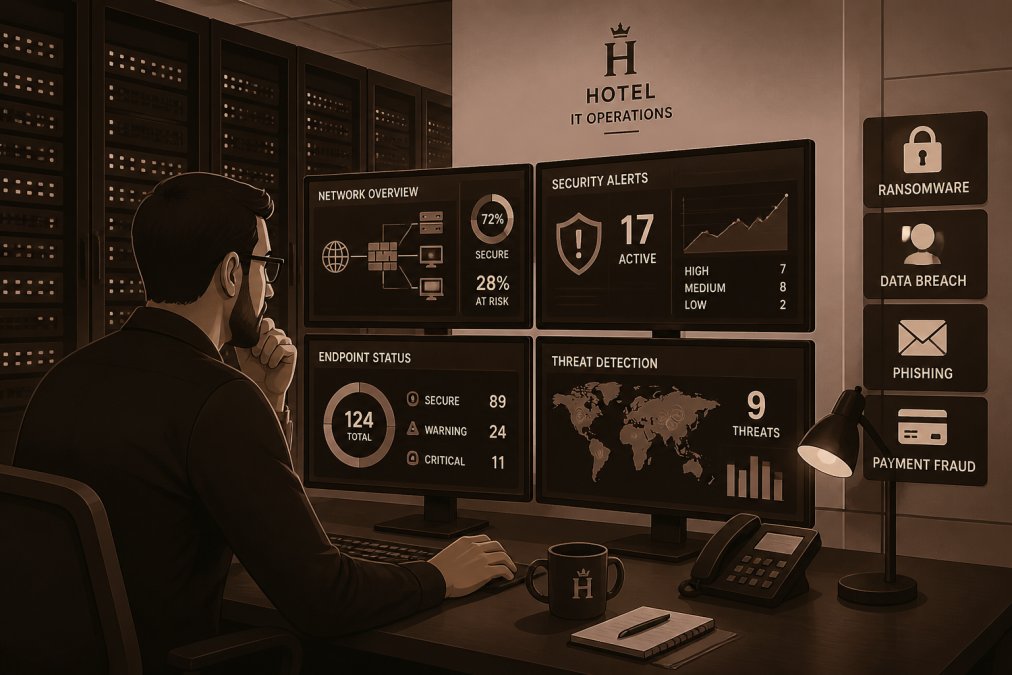
The coverage framework splits into two distinct buckets: understanding both is the difference between a successful claim and absorbing a six-figure loss.
First-Party Coverage: Your Direct Costs
First-party coverage addresses financial losses your hotel suffers directly from ransomware or data breach. A comprehensive policy typically covers:
- Ransom demand payments: Extortion costs paid to threat actors, subject to policy limits and insurer approval
- Forensic investigation: Costs to identify how the compromise occurred, what data was accessed, and whether the threat is contained
- System restoration and data recovery: Labor and software costs to rebuild systems and recover encrypted assets
- Business interruption: Lost revenue while your property management system, booking platform, or payment infrastructure is offline
- Notification costs: Mandatory breach notifications to affected guests and regulators
- Crisis management and public relations: Reputation damage response and PR budget
Business interruption coverage deserves particular attention. A ransomware attack taking your PMS offline for 48 hours means front desk operations halt, loyalty points can't be redeemed, and restaurant POS systems go dark. Financial loss accumulates quickly.
Third-Party Liability: Your Guests' Costs
Third-party liability coverage addresses claims made against your hotel by guests, business partners, or regulators because of a breach affecting their data. This includes legal defense costs, regulatory fines from bodies enforcing laws like the California Consumer Privacy Act, consumer redress funds, and payment card industry penalties. According to the FTC's guidance on data security for businesses, companies failing to implement reasonable safeguards face enforcement actions on top of private litigation.
For hotels handling international guests, GDPR obligations can trigger notification requirements and potential penalties. A policy covering regulatory fines and legal defense is essential for any property processing significant guest data.
Cyber Insurance Ransomware Exclusions You Must Know
The more important question is what cyber insurance doesn't cover, because that's where claims get denied.
Cyber insurance ransomware exclusions are clauses that void coverage under specific circumstances. Carriers have tightened these significantly as ransomware frequency and severity have increased.
State-Sponsored Attack Exclusions
Many cyber liability policies contain a "war exclusion" or "nation-state exclusion" that voids coverage when an attack is attributed to a foreign government or state-sponsored threat actor. Attribution is problematic: when a ransomware group operates with implicit state backing, the line between criminal and state-sponsored activity blurs. As documented in CISA's advisory on ransomware trends, many destructive ransomware campaigns have suspected state-affiliated connections.
If your insurer attributes an attack to a state-sponsored actor, they may deny the claim entirely. Some carriers now offer explicit carve-backs restoring coverage even when state involvement is alleged but not proven, worth asking about when comparing policies.
Pre-Existing Vulnerabilities and Failure to Maintain Controls
Carriers can deny claims when forensic investigation reveals the breach exploited a vulnerability the hotel knew about and failed to remediate. Common triggers include unpatched software with known CVEs, multi-factor authentication not enabled on remote access, end-of-life operating systems in production, and failure to maintain tested backups.
Underwriters increasingly review forensic reports against security controls declared during application. A mismatch between stated and actual controls is grounds for denial.
Cyber Insurance Requirements for Coverage Approval
The underwriting process for cyber liability insurance has changed dramatically. Today's application process resembles a security audit more than a simple questionnaire.
Security Controls Underwriters Expect
Meeting cyber insurance requirements for coverage typically means demonstrating specific controls. Underwriters have converged on a common baseline, and properties unable to show evidence face higher premiums, reduced limits, or declination.
| Security Control | Why Underwriters Require It | Risk if Absent |
|---|---|---|
| Multi-factor authentication on all remote access | Blocks credential-based entry points | Policy may be voided if MFA was misrepresented |
| Endpoint detection and response (EDR) | Enables threat detection before encryption | Carrier may reduce payout if EDR was absent |
| Immutable, offsite backups tested quarterly | Limits ransomware impact and recovery cost | Business interruption claim weakened |
| Privileged access management (PAM) | Limits lateral movement after initial compromise | Underwriters view absence as elevated risk |
| Employee security awareness training | Reduces phishing susceptibility | May affect renewal terms after a claim |
| Incident response plan, documented and tested | Demonstrates pre-bind readiness | Affects claims response timeline |
Hotels face specific challenges: property management systems, guest Wi-Fi, and point-of-sale terminals often run on the same network segment, creating lateral movement opportunities. Underwriters know this. Demonstrating network segmentation is increasingly required.
Duty to Defend vs. Duty to Indemnify: Why It Matters
Duty to Defend means the insurer manages your legal defense when a third-party claim is filed. They appoint counsel, direct strategy, and bear costs. You don't front fees while waiting for reimbursement.
Duty to Indemnify means the insurer reimburses you for covered losses after you've incurred and paid them. You manage the response, engage counsel, and submit costs for reimbursement. Financial exposure during the incident falls on you.
During a ransomware event, the difference is significant. A Duty to Defend policy engages your insurer's incident response resources immediately. A Duty to Indemnify policy means you manage the crisis first and negotiate reimbursement later. For a small independent hotel without in-house legal counsel, that distinction determines whether an incident is managed or chaotic.
Review your policy's defense obligations carefully. Some policies include hybrid structures: Duty to Defend for third-party liability, Duty to Indemnify for first-party costs. Know which applies to which coverage component before you need it.
Ransomware Negotiation Services and Incident Response
A quality cyber insurance policy doesn't just pay for ransomware attacks, it funds the team responding to them.
When ransomware locks your systems, the insurer's incident response process typically activates within hours. This includes access to a dedicated breach response team coordinating forensic containment, assessing whether the threat actor's decryption tool is trustworthy, and managing ransom negotiation.
Ransomware negotiation is specialized. Experienced negotiators understand threat actor behavior, typical discount ranges, and signals indicating whether a group will provide working decryption keys. According to the FBI's ransomware guidance for businesses, paying a ransom does not guarantee data recovery and may expose organizations to additional risk, exactly why professional negotiators matter.
The insurer's incident response vendors also handle malware analysis, attacker attribution, evidence preservation for law enforcement, guest and regulator communication, and payment card brand coordination if PCI data was compromised. For Best Cyber Insurance for Hotels clients, 24-hour access to a dedicated breach response team means this process starts immediately, even at 2 AM on Sunday.
How to File a Cyber Insurance Claim After Ransomware
Filing a cyber insurance claim correctly in the first hours of an attack directly affects your recovery timeline and coverage likelihood. Most denials trace back to missteps in initial notification.

Follow this sequence precisely:
- Notify your insurer immediately. Most policies require notification within 24-72 hours of discovering an incident. Missing this window affects coverage. Call the claims line before contacting a public IT vendor.
- Do not pay the ransom without insurer approval. Paying without authorization can void reimbursement. Your insurer must approve and often facilitate ransom payments through sanctioned channels.
- Preserve evidence. Do not wipe or rebuild affected systems before forensic imaging. Destroying evidence compromises both investigation and your claim.
- Document all costs from the first hour. Every vendor engagement, staff overtime, and out-of-pocket expense needs a paper trail. Undocumented costs are unrecoverable.
- Submit a formal proof of loss. Your insurer will provide a specific form and timeline. Missed deadlines are a common reason claims are delayed or partially denied.
- Cooperate fully with forensic investigation. Your policy likely requires cooperation. Restricting system or log access gives the carrier grounds to dispute the claim.
The claims process moves faster with advance preparation: a documented incident response plan, current asset inventory, and clear record of security controls in place at attack time.
How Ransomware Claims Affect Your Future Premiums
Filing a ransomware claim changes your relationship with your insurer. That's not a reason to avoid filing a legitimate claim, but it is a reason to understand what comes next.
The impact depends on several factors: loss severity, whether forensic investigation revealed security control failures, how quickly you remediated the root cause, and what improvements you've implemented before renewal. Many carriers apply a surcharge at renewal following ransomware events. Some non-renew if claims revealed significant security deficiencies not addressed.
Treat the forensic report as a remediation roadmap. Carriers respond positively when hotels demonstrate every finding has been addressed. Documented improvements, new EDR deployment, MFA rollout, network segmentation, can offset the actuarial weight of a prior claim. As noted in NIST's cybersecurity framework for organizations, organizations adopting structured approaches to identifying and mitigating cyber risks demonstrate materially lower incident recurrence rates. Underwriters know this. Showing you've implemented a recognized framework after a claim is a strong renewal signal.
Cyber insurance premiums across hospitality have reflected increased ransomware frequency. Properties investing in demonstrable security hygiene before and after a claim fare better at renewal than those treating insurance as a substitute for security investment.
Ransomware is the most financially damaging cyber threat facing hotels today. The gap between a policy that actually responds and one that technically exists is significant. Best Cyber Insurance for Hotels provides specialized cyber liability coverage built for hospitality, with an instant quote process and 24-hour access to a dedicated breach response team that activates the moment an incident is confirmed. Get an instant quote and ensure your property has coverage that holds up when it matters.
Frequently Asked Questions
Does cyber liability insurance cover the cost of ransom payments?
Most cyber liability insurance policies do cover ransom payments as part of extortion costs, but coverage is not automatic. Your policy must specifically include a ransomware or cyber extortion endorsement. Insurers typically require you to notify them before any payment is made, and they may deploy ransomware negotiation services to attempt to reduce the demand. Coverage limits, deductibles, and pre-approval requirements vary by policy, so review your terms carefully before an incident occurs.
What are the most common exclusions in ransomware insurance policies?
The most common cyber insurance ransomware exclusions include state-sponsored or nation-state attacks, incidents caused by unpatched systems or known vulnerabilities you failed to address, and attacks originating from an insider threat. War exclusions have become a major point of dispute in recent claims. Policies may also exclude coverage if you did not meet the security controls required at binding, such as multi-factor authentication or endpoint detection. Always read the exclusions section before purchasing.
How do insurance companies verify ransomware claims?
After you report an incident, the insurer assigns a forensic investigation team to confirm the attack occurred, identify the threat actor, and document the scope of the network compromise. Investigators examine logs, system backups, and communications to verify the claim matches your policy terms. They check whether required security controls were active at the time of the attack. This process determines what the insurer will pay toward ransom demands, data recovery, business interruption losses, and notification costs.
What security requirements do insurers expect before issuing a cyber insurance policy?
Underwriters now treat cyber hygiene as a condition of coverage, not just a recommendation. Common cyber insurance requirements for coverage include multi-factor authentication on all remote access and email, endpoint detection and response tools, regular offsite data backups, employee phishing training, and a documented incident response plan. Hotels handling payment card data face additional scrutiny. Failing to maintain these controls after binding can void your claim, even if the attack itself would otherwise be covered.
This article was written using GrandRanker