 how-to
Hotel Cyber Attack Response: 7 Critical Steps
Table of Contents
- What to Do in the First Hour of a Hotel Cyber Attack
- Isolate and Secure Your Digital Endpoints
- Activate Your Incident Response Plan Template for Hospitality
- Does Cyber Insurance Cover Ransomware and Recovery Costs
- Hotel Data Breach Notification Requirements and Timeline
- Preserve Forensics Evidence and Document Everything
- Communicate With Guests and Manage Your Reputation
- Frequently Asked Questions
Last Updated: September 19, 2026
What to Do in the First Hour of a Hotel Cyber Attack
A hotel cyber attack response begins the moment you detect something wrong. The first 60 minutes determine whether you contain the breach or watch it spread. (Source: guidance from the Cybersecurity and Infrastructure Security Agency (CISA))
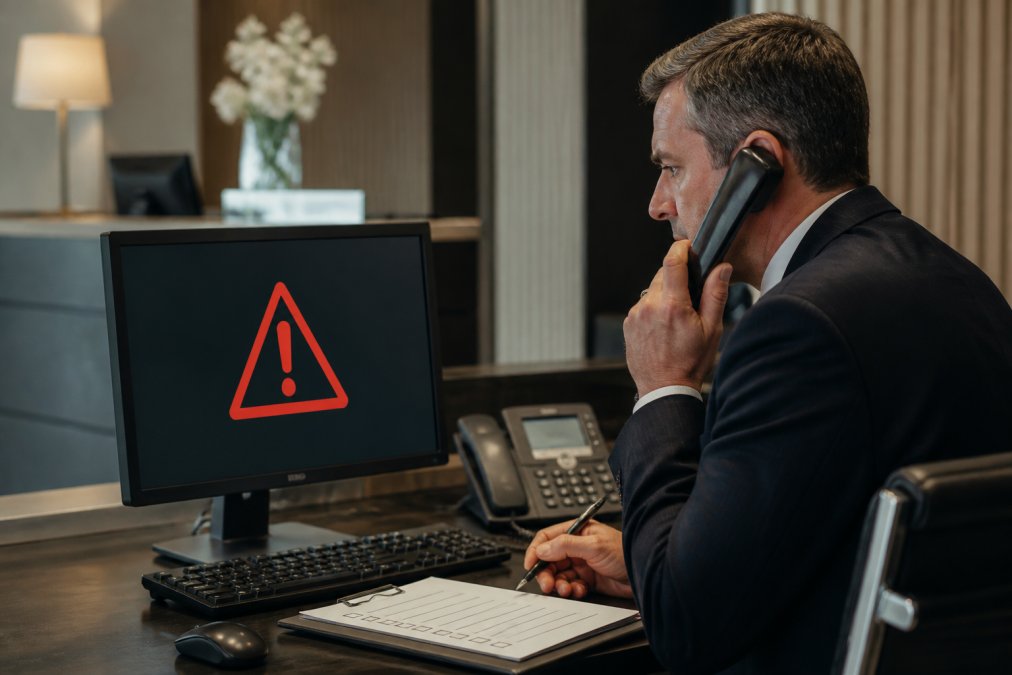
Your immediate priorities: stop the spread, document what happened, and notify the right people.
Here's what happens in the first hour:
- Identify the breach, Look for signs: unusual network activity, locked files, ransom notes, guest payment systems down, or staff unable to log in
- Isolate affected systems, Disconnect the compromised device from the network immediately (unplug ethernet, disable WiFi)
- Activate your incident response team, Call your IT director, your general manager, and your cyber insurance provider if you have one
- Preserve evidence, Don't delete anything. Don't restart systems. Document timestamps and what you saw
- Notify key staff, Tell your front desk, reservations, and housekeeping that systems may be down; prepare for manual operations
Document first, then act.
Isolate and Secure Your Digital Endpoints
Isolating your endpoints stops lateral movement, this is where your hotel cyber attack response either succeeds or fails. A digital endpoint is any device on your network: computers, servers, payment terminals, door locks, security cameras, printers, and guest WiFi. One compromised endpoint can infect all others if not isolated fast.
Your isolation strategy:
- Disconnect the infected device immediately, Pull the network cable or disable WiFi. Do this before anything else
- Identify all connected devices, Your IT team should document what was on the same network segment
- Segment your network, Guest WiFi should be separate from your internal systems. Payment systems should be isolated from general office computers
- Check for lateral movement, Look for signs the attacker accessed other devices: unusual login attempts, new user accounts, changed passwords
- Take offline backups, If you have clean backups from before the attack, disconnect them from the network and secure them physically
Activate Your Incident Response Plan Template for Hospitality
An incident response plan template for hospitality gives you a playbook before the attack happens.
Your incident response plan template should include:
- Contact list, IT director, general manager, legal counsel, insurance company, law enforcement, forensics firm, and PR team with phone numbers and after-hours contacts
- Chain of command, Who makes decisions? Who approves spending? Who talks to guests?
- System inventory, What systems do you have? Which ones handle guest data? Which are critical to operations?
- Data inventory, Where is guest information stored? Payment card data? Passport numbers? Email addresses?
- Communication templates, What do you say to guests? Staff? Law enforcement? Insurance?
- Recovery procedures, How do you restore systems? Who has admin credentials? Where are backups stored?
- Roles and responsibilities, Who does what? Who manages forensics? Who handles guest communication?
Does Cyber Insurance Cover Ransomware and Recovery Costs
Cyber insurance coverage depends on your specific policy. Not all policies cover ransomware payments, and some have strict limits on recovery costs.
Your policy typically covers:
- Forensics investigation, Hiring experts to determine what happened and how
- Data restoration, Recovering files from backups or paying for recovery services
- Business interruption, Lost revenue while systems are down (usually capped at 30-60 days)
- Notification costs, Mailing letters to affected guests, credit monitoring services
- Legal and regulatory fines, Some coverage for state notification law penalties and attorney fees
- Ransomware negotiation, Professional negotiators who deal with attackers (not paying the ransom directly)
- Incident response retainer, Pre-incident access to breach counsel, forensics firms, and PR specialists
What's often NOT covered:
- Ransom payments, Most policies won't pay the ransom itself, though some cover negotiation services
- Cryptocurrency, If you pay in Bitcoin or other digital currency, some policies exclude it
- Preventable attacks, If forensics finds you ignored basic security (unpatched systems, no MFA), coverage may be denied
- Third-party liability, If guest data is exposed due to a vendor breach, liability coverage may be capped or excluded
- Reputational harm, Lost bookings and brand damage are rarely covered
The Claims Process During Active Response
Your insurance company expects documentation to begin immediately:
-
Notify your insurer immediately. Call your broker or insurance company's claims hotline the moment you confirm a breach. Most policies require prompt notification; delaying can void coverage.
-
Assign a claims contact. Your insurance company will assign an adjuster who becomes your liaison for all coverage questions.
-
Document all costs in real time. Create a spreadsheet with date, description, amount, vendor name, invoice number, and category. Adjusters review expenses chronologically, and gaps raise red flags.
-
Preserve all vendor invoices and receipts. Email them to your claims adjuster as they arrive, not at the end.
-
Track business interruption losses. Collect average daily revenue, occupancy rate, estimated lost bookings, and staff costs. Calculate daily.
-
Get written approval before major spending. Email your adjuster before hiring a forensics firm or negotiator to confirm coverage and preferred vendors.
-
Document the attack timeline. Create a written timeline with timestamps showing discovery, confirmation, isolation, guest notification, and restoration.
The Gap Between Policy and Reality
Hotel Data Breach Notification Requirements and Timeline
Hotel data breach notification requirements vary by state, but you must notify affected guests without unreasonable delay, typically within 30-60 days.
Preserve Forensics Evidence and Document Everything
Preserve evidence: document timestamps in a written log, take screenshots of error messages and unusual activity, preserve system logs without clearing or restarting, isolate affected devices, disconnect backups from the network, and save all attacker communications and ransom demands.
Communicate With Guests and Manage Your Reputation
Guest communication during a hotel cyber attack response is where most hotels fail. Silence creates panic and drives guests to social media. Here are templates and specific language you can adapt immediately.
Subject: Important Security Notice Regarding Your Recent Stay
Dear [Guest Name],
Sincerely, [General Manager Name] [Hotel Name]
Staff Communication (Send Immediately, Before Guest Notification)
Subject: Security Incident, What to Tell Guests
Team,
If a guest asks about this:
-
Do not speculate. Stick to the facts: "We experienced a security incident. We notified guests via email with details and next steps."
-
Do not apologize excessively. One "We apologize" is enough. Repeated apologies make guests more anxious.
-
Direct them to the email. "You should have received an email from our general manager with details. If you didn't receive it, I can provide you with our dedicated contact information."
-
Offer the credit monitoring link. "We are providing complimentary credit monitoring. Here's the enrollment link: [URL]."
-
Do not discuss payment card security. If a guest asks if their card was compromised, say: "Our investigation found no evidence that payment card information was accessed. For specific questions about your account, please contact [dedicated email or phone]."
Media/Public Statement (Prepare Before You Need It)
[Hotel Name] Security Incident Statement
Post-Incident Reputation Management Timeline
What NOT to Do
Frequently Asked Questions
What is the first thing to do during a hotel cyber attack?
Immediately disconnect affected systems from your network to prevent the attack from spreading. Notify your IT team or managed security provider, then activate your incident response plan. Contact your cyber insurance provider's breach response team promptly, most policies require prompt notification. Do not shut down systems entirely unless instructed; forensic teams need evidence preserved. Document the time you discovered the attack and any visible indicators of compromise.
Does cyber insurance cover ransomware payments and recovery costs?
Coverage depends on your specific policy. Many cyber insurance policies cover ransomware response costs, including forensic investigation, data recovery services, and business interruption losses. Some policies also cover ransom negotiation services and extortion payments, though this varies by carrier. Recovery costs, restoring systems and data, are typically covered. Review your policy details or contact your carrier immediately after an attack to confirm what's covered and activate your breach response team.
What are the mandatory hotel data breach notification requirements?
Hotels must notify affected guests without unreasonable delay under state data breach notification laws. Most states require notification if personally identifiable information (PII), such as payment card data, Social Security numbers, or passport information, is accessed or acquired without authorization. Notification must be clear and include details of the breach, the data affected, and steps guests should take to protect themselves. Some states require notification to the state attorney general if more than a certain number of residents are affected.
How should hotels communicate with guests after a cyber attack?
Prepare a clear, factual breach notification letter that explains what happened, what data was affected, and what guests should do to protect themselves (monitor accounts, place fraud alerts, etc.). Include your contact information and details about any free credit monitoring you're offering. Send notifications promptly via email, mail, or phone depending on the contact information you have. Be transparent about the incident without admitting liability. Assign one spokesperson to handle media inquiries. Provide a dedicated phone line or email for guest questions. Consider offering credit monitoring or identity theft protection as part of your response, this can help with reputation recovery and may be covered by your cyber insurance.
A hotel cyber attack response isn't something you handle alone. Your incident response plan, your forensics team, your legal counsel, and your cyber insurance provider all work together to contain the damage, preserve evidence, and protect your guests. Best Cyber Insurance for Hotels provides 24-hour access to a dedicated breach response team that guides you through every step. Get an instant quote today and know you're protected when it matters most.