 how-to
How to Buy Hotel Cyber Insurance: A Step-by-Step Guide
Table of Contents
- What Hotel Cyber Insurance Covers
- Cyber Security Requirements for Hotel Insurance
- Understanding Hotel Data Breach Insurance Cost
- Ransomware Coverage for Hotels: What You Need
- Steps to Prepare for a Cyber Insurance Application
- How to Get Your Instant Quote
- What Happens After You Buy: The Claims Process
- Conclusion
Last Updated: August 18, 2026
What Hotel Cyber Insurance Covers
Hotel cyber insurance protects your property against digital threats targeting the hospitality industry. This specialized coverage addresses risks that standard business policies don't handle: data breaches affecting guest payment information, ransomware attacks that shut down reservation systems, and resulting legal and regulatory consequences.
Coverage splits into two main categories: first-party and third-party protection. First-party covers your direct losses, forensic investigation, data recovery, business interruption, and guest notification costs. Third-party liability protects you when guests or regulators seek damages, including legal defense costs and settlements.
Most policies cover ransomware payments and extortion demands. When criminals encrypt your booking system or threaten to release guest data, your insurer coordinates incident response and connects you with negotiation specialists. This is critical for independent properties lacking the IT infrastructure of larger chains.
Coverage extends to regulatory fines and penalties. GDPR violations for international guests or CCPA fines for California visitors are covered. You also get crisis management support, PR guidance, customer notification assistance, and sometimes credit monitoring services for affected guests.
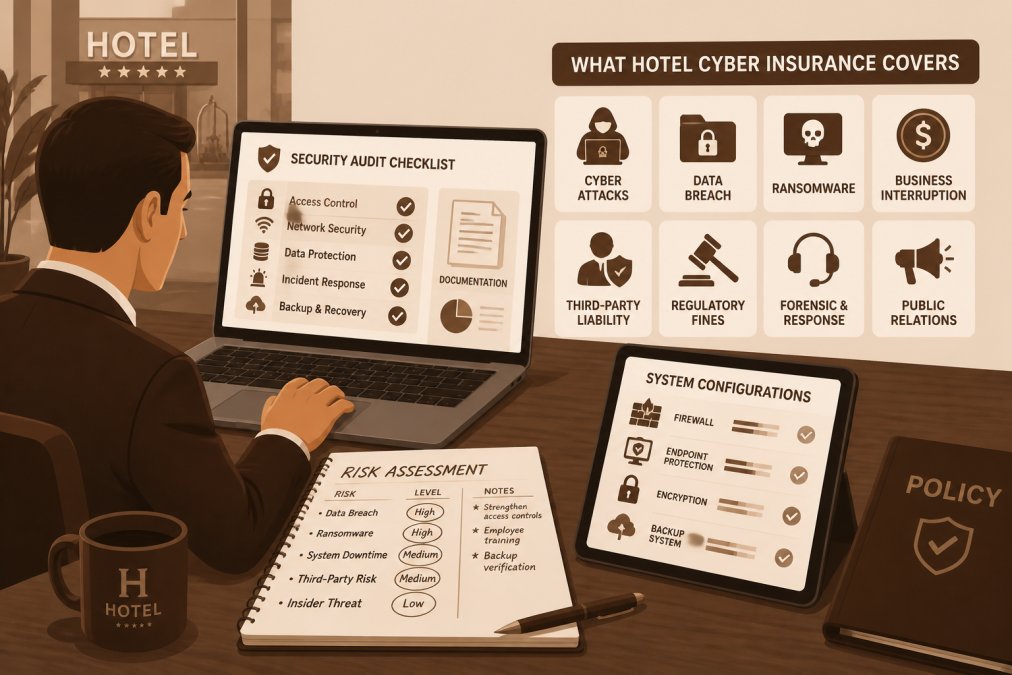
Coverage also includes social engineering and phishing attacks. If an employee transfers funds to a fraudulent account or reveals access credentials after a convincing email, that's covered. For hotels managing payment card data through PMS systems, this protection is essential.
Cyber Security Requirements for Hotel Insurance
Insurance underwriters evaluate your actual security posture before offering coverage. You need demonstrable, documented protections, not perfect security, but reasonable controls.
Most insurers require multi-factor authentication on administrative accounts. If someone can access your PMS system with just a username and password, you'll face denial or significantly higher premiums. This directly reduces breach likelihood.
You'll need a written incident response plan. This doesn't need to be elaborate, just outline who gets notified if a breach occurs, what immediate steps your team takes, and how you'll communicate with guests and regulators. Underwriters want evidence you've thought through response before crisis hits.
Regular security assessments are increasingly expected. This could mean annual penetration testing, vulnerability scans, or documented reviews of your security controls. The goal is showing you actively manage risk rather than ignoring it.
Data encryption is standard. Guest payment information, personal identification data, and reservation details should be encrypted in transit and at rest. For cloud-based PMS systems, verify encryption is enabled and confirm the standards used.
Employee training matters significantly. A single employee clicking a malicious link can compromise your entire network. Underwriters ask about security awareness training on phishing, social engineering, and password security. Documentation of annual training strengthens your application.
Access control is key. Not every staff member needs access to guest payment data. Housekeeping doesn't need credit card numbers. Front desk staff shouldn't access HR files. Limiting access to what each role needs reduces your attack surface.
Understanding Hotel Data Breach Insurance Cost
Hotel cyber insurance costs vary based on factors reflecting your risk profile. Property size matters, a 50-room boutique property pays significantly less than a 300-room resort. Annual revenue influences premiums because it correlates with guest transaction volume and data handled.
Your security posture is the single largest cost driver after size and revenue. Properties with documented multi-factor authentication, regular security assessments, and incident response plans pay less than those with minimal controls. This reflects actual breach likelihood.
Your PMS system type affects pricing. Modern, regularly updated cloud-based systems from vendors like Oracle Hospitality get better rates than legacy on-premise systems you manage yourself.
Claims history matters. No previous breaches means lower premiums. Previous incidents require explanation of what happened, how you responded, and what changes you've made.
Location and state regulations play a role. States with stronger data protection laws have higher premiums due to greater regulatory risk. California properties face different exposure than those in states with minimal data privacy requirements.
For specific pricing, get a quote from Best Cyber Insurance for Hotels based on your actual property details. The cost is typically far less than potential breach costs, making it a straightforward financial decision.
Ransomware Coverage for Hotels: What You Need
Ransomware is the attack vector keeping hotel owners up at night. Criminals encrypt your reservation system, payment processing, and guest management platform, holding your business hostage until you pay. Even 24 hours of downtime means lost bookings, angry guests, and reputation damage extending far beyond the incident.
Ransomware coverage addresses several scenarios. First, it covers incident response costs, bringing in forensic specialists, negotiation experts, and technical consultants to assess the attack and determine your options. These specialists cost thousands per day but are essential for informed decisions under pressure.
Second, the policy covers a portion of recovery costs, including specialized data recovery services or ransom negotiation and payment logistics if you choose that path. While it won't cover the full ransom in most cases, it covers significant portions of response and recovery expenses.
Third, ransomware coverage includes business interruption protection. If your PMS goes down, you lose revenue. The policy reimburses lost income during system restoration. For a 100-room property at $150 per night, that's $15,000 daily, a 48-hour recovery represents $30,000 in losses the policy helps cover.
Cyber extortion coverage is included. If criminals threaten to release guest data or launch attacks unless you pay, you get access to negotiation specialists and law enforcement coordination, plus coverage for threat resolution payments if you choose to pay.
Ransomware coverage isn't just about paying the ransom, it's about professional support, rapid response, and financial protection during a worst-case scenario. Best Cyber Insurance for Hotels includes 24-hour access to a dedicated breach response team, so you're not making decisions alone at 2 AM when systems are encrypted.
Steps to Prepare for a Cyber Insurance Application
Getting approved for hotel cyber insurance requires systematic preparation. Start by documenting your current security posture. List all systems handling guest data, your PMS, payment processor, email system, Wi-Fi network, cloud services. For each, document security controls: multi-factor authentication, data encryption, update frequency.
Create a simple incident response plan if you don't have one. Write down who gets notified if a breach occurs, what immediate steps you'll take, and how you'll communicate with guests and regulators. A one-page plan is acceptable for small properties.
Gather documentation of any security assessments. If you've had vulnerability scans, penetration tests, or security audits in the past two years, pull those reports. If not, be prepared to discuss your security practices during underwriting.

Document employee security training. Have you conducted training on phishing, password security, or social engineering? Even informal training counts, just document when and what was covered. If you haven't done training yet, plan to implement it before applying.
Verify your PMS vendor's security credentials. Get documentation showing encryption used, security certifications held, and incident response procedures. For major cloud-based systems, this information is usually available on their security or compliance page.
Prepare a brief property description: number of rooms, annual revenue, payment methods accepted, whether you handle international guests, and any previous security incidents. Be honest about previous incidents, underwriters will find out anyway, and transparency during application is better than surprises later.
List compliance requirements you're subject to. GDPR applies if you handle international guest data. CCPA applies for California guests. PCI DSS compliance is required for payment card acceptance. Underwriters want to understand your regulatory landscape.
How to Get Your Instant Quote
The quote process with Best Cyber Insurance for Hotels is designed for speed. Start with basic property information: number of rooms, annual revenue, location, and property type. This takes about five minutes.
Next, answer questions about your current security posture. Do you have multi-factor authentication? Do you encrypt guest data? Have you had security assessments? Do you have an incident response plan? Answer honestly, there's no penalty for early-stage security maturity, and transparency leads to better coverage terms.
Provide details about your PMS system and payment processing. What system do you use? Is it cloud-based or on-premise? How many staff have administrative access? How often do you update? These details help underwriters assess technical risk.
The system generates an instant quote showing coverage options and annual premiums. You'll see first-party and third-party coverage, deductible options, and available add-ons. This gives concrete pricing before commitment.
If you move forward, provide additional documentation: proof of security controls, your incident response plan, details about any previous incidents. Underwriting typically takes 3-5 business days, during which an underwriter may ask clarifying questions.
Once underwriting is complete, you'll receive formal quote and policy documents. Review carefully to ensure coverage limits match your needs, deductibles are acceptable, and exclusions don't create unexpected gaps. Most policies are effective immediately after payment.
The entire process from initial quote to active coverage typically takes one to two weeks. Properties with completed security assessments and ready documentation move faster. Best Cyber Insurance for Hotels's instant quote approach lets you see pricing and coverage options immediately rather than waiting days for preliminary quotes.
What Happens After You Buy: The Claims Process
Understanding the claims process before you need it reduces stress if a breach occurs. When you discover a cyber incident, ransomware, data breach, or social engineering fraud, contact your insurer immediately. With Best Cyber Insurance for Hotels, you have 24-hour access to a dedicated breach response team. You reach a specialist immediately without waiting for business hours.
The response team assesses the incident. Is this a confirmed breach or potential threat? How many systems are affected? What data was accessed? Based on this assessment, the team coordinates your next steps. For ransomware, they connect you with negotiation specialists. For data breaches, they help engage forensic investigators to determine compromise scope.
Your insurer covers specialist costs, forensic investigation, incident response coordination, legal consultation on notification requirements. You're not paying out of pocket for expert help during crisis.
If you need to notify affected guests, your insurer helps coordinate the process. They advise on legally required disclosures, clear communication, and whether to offer credit monitoring. They may cover notification and credit monitoring costs.
For regulatory reporting, your insurer's legal team helps you understand filing requirements and manages the regulatory process.
If you face lawsuits or regulatory fines, coverage includes legal defense. Your insurer assigns counsel and covers defense costs. Settlements or judgments are covered up to policy limits.
With a good insurer, the claims process isn't adversarial. Your insurer's goal is helping you recover quickly and minimize damage. They have financial incentive to resolve claims efficiently.
Document everything during an incident, your response steps, contacts, decisions and reasoning. This documentation helps with claims substantiation and ensures full coverage for eligible expenses.
Cyber threats against hotels are accelerating, and breach consequences are severe. Between guest notification costs, forensic investigation, potential regulatory fines, and business interruption, a single incident can cost hundreds of thousands of dollars. Hotel cyber insurance transforms that catastrophic risk into a manageable expense.
Best Cyber Insurance for Hotels specializes in protecting properties like yours with instant quote processing, 24-hour dedicated breach response teams, and coverage specifically designed for hospitality operations. Rather than navigating generic cyber insurance, you get protection built for the specific threats hotels face: PMS system compromises, payment card breaches, ransomware attacks targeting reservation systems, and resulting regulatory exposure.
The National Institute of Standards and Technology's Cybersecurity Framework provides guidance on security controls that insurers expect. The Federal Trade Commission's guidance on data breach notification outlines your legal obligations when a breach occurs. The Payment Card Industry Security Standards Council defines compliance requirements for handling payment card data.
Get an instant quote from Best Cyber Insurance for Hotels today. See your coverage options and pricing in minutes, understand exactly what's protected, and get your property covered before the next threat emerges.
| Step | Timeline | Key Action |
|---|---|---|
| Information gathering | 5-10 minutes | Provide property details and security practices |
| Instant quote generation | Immediate | Review coverage options and pricing |
| Documentation submission | 1-3 days | Submit security assessments and incident response plan |
| Underwriting review | 3-5 business days | Underwriter asks clarifying questions if needed |
| Policy approval | 1-2 days | Receive formal quote and policy documents |
| Coverage activation | Same day | Coverage begins after payment |
Frequently Asked Questions
What does cyber insurance cover for hotels?
Hotel cyber insurance covers first-party costs like data recovery, forensic investigation, and business interruption losses when your systems go down. Third-party liability coverage pays for legal expenses, regulatory fines, and customer notification if guest data is breached. Ransomware coverage includes extortion payments and recovery costs. The specific coverage depends on your policy limits and deductible. Request a quote to see exactly what protections apply to your property.
Why do hotels need specialized cyber liability insurance?
Hotels handle payment card data, guest names, addresses, and passport information daily. A single breach can trigger PCI DSS compliance violations, state data breach notification laws, and lawsuits from affected guests. General liability and property policies do not cover cyber incidents. Specialized hotel cyber insurance protects against these hospitality-specific risks with incident response teams trained in hotel operations and breach protocols.
What are the minimum security requirements to qualify for hotel cyber insurance?
Insurers typically require multi-factor authentication for staff accounts, regular security updates on your PMS and payment systems, employee training on phishing and social engineering, and an incident response plan. Some policies require annual security assessments. The exact requirements depend on your property size and data handling practices. During the quote process, we'll review your current security posture and identify any gaps before underwriting.
How much does hotel cyber insurance cost?
Pricing depends on your property size, guest volume, payment processing methods, existing security controls, and coverage limits. A small boutique hotel has different risk factors than a large chain. Rather than guessing, get an instant quote tailored to your specific operation. Your quote will show the premium, deductible options, and coverage limits so you can make an informed decision.
This article was written using GrandRanker