 ultimate-guide
Incident Response Planning for Hotel Groups
Table of Contents
- Why Incident Response Planning Matters for Hotel Groups
- Building Your Hotel Data Breach Response Checklist
- Developing an Incident Response Plan Template for Hospitality
- Centralized Security Management and Threat Intelligence
- Cyber Insurance for Hotels: Your Incident Response Backbone
- Testing Your Plan: Incident Response Tabletop Exercises
- Post-Incident Forensic Analysis and Recovery
- Frequently Asked Questions
Last Updated: September 25, 2026
Why Incident Response Planning Matters for Hotel Groups
A data breach at a hotel chain can shut down reservations, expose guest payment information, trigger regulatory fines, and destroy customer trust in days. Yet most hotel groups operate without formal incident response planning for hotel groups.
Your property management system holds credit card numbers, passport details, and personal information for thousands of guests. A ransomware attack stops check-ins, prevents room access, and forces manual operations. Data breach notification alone can cost tens of thousands in legal and forensic fees. This is why incident response planning for hotel groups has become essential.
The hotels that survived recent attacks weren't the ones with the most advanced technology, they were the ones with a documented plan, trained staff, and immediate access to specialized response teams.
Building Your Hotel Data Breach Response Checklist
A hotel data breach response checklist serves as your playbook during an incident. Without it, your team wastes hours deciding who to call and what to do first.
Detection and Initial Containment
The first 60 minutes after detecting a breach determine whether you contain the damage or let it spread. Detection often comes from a guest unable to check in, unusual payment processor activity, or suspicious network traffic.
Isolate affected systems from the network and preserve evidence before shutting anything down, forensic analysis depends on what you capture now. Assign one person to document when the issue was discovered, what systems show compromise, and what data might be exposed.
For multi-location properties, implement a system where any property manager can immediately escalate suspicious activity to a central security team. Delayed notification means lost control of the response.
Notification and Escalation Steps
Your incident escalation protocol should specify exactly who gets called, in what order: your incident response team, your cyber insurance provider, your legal counsel, and your forensic investigators.
Call your cyber insurance company first. Waiting days means making costly decisions without expert guidance. If you're still evaluating coverage options, an Instant Cyber Insurance Quote can help you understand what protection is available for your specific property portfolio and guest volume.
Notify your payment processor and third-party systems connected to your PMS. Guest notification is regulated, typically 30 to 60 days depending on state, but faster notification builds trust. Prepare a notification template in advance explaining what happened, what data was exposed, your response steps, and free protections offered.
Developing an Incident Response Plan Template for Hospitality
Your incident response plan must address hotel-specific vulnerabilities: 24/7 operations, thousands of daily guest transactions, and frontline staff with varying technical knowledge.
Core Components Every Hotel Must Include
A complete incident response plan includes six core sections: preparation, detection, containment, eradication, recovery, and post-incident review, each defining roles, responsibilities, and specific actions.
Assign specific roles: incident commander (coordinates response), technical lead (system isolation and forensic preservation), communications lead (internal and external messaging), and compliance officer (regulatory requirements). For multi-property groups, the incident commander is at corporate with property managers as on-site coordinators.
Document critical systems and data flows: which hold guest payment data, which connect to your reservation engine, which manage room access. This enables quick determination of what's compromised and what needs isolation.
Multi-Location Policy Enforcement Across Your Properties
Multi-location policy enforcement is where most hotel groups fail. Your incident response plan must include mechanisms that enforce the same security standards across every property.
Document security policies for all properties covering password management, access controls, payment processing, and incident reporting. Use your PMS to enforce these technically: require password complexity, disable remote access except through approved VPNs, and require multi-factor authentication for sensitive systems.
Conduct quarterly security training at every property. Frontline staff must recognize phishing emails, understand password security, and know how to report suspicious activity. A single employee clicking a phishing link can compromise your entire network.
Implement a centralized incident reporting system allowing any property manager to immediately escalate concerns to corporate security. Make reporting easy and non-punitive.
Centralized Security Management and Threat Intelligence
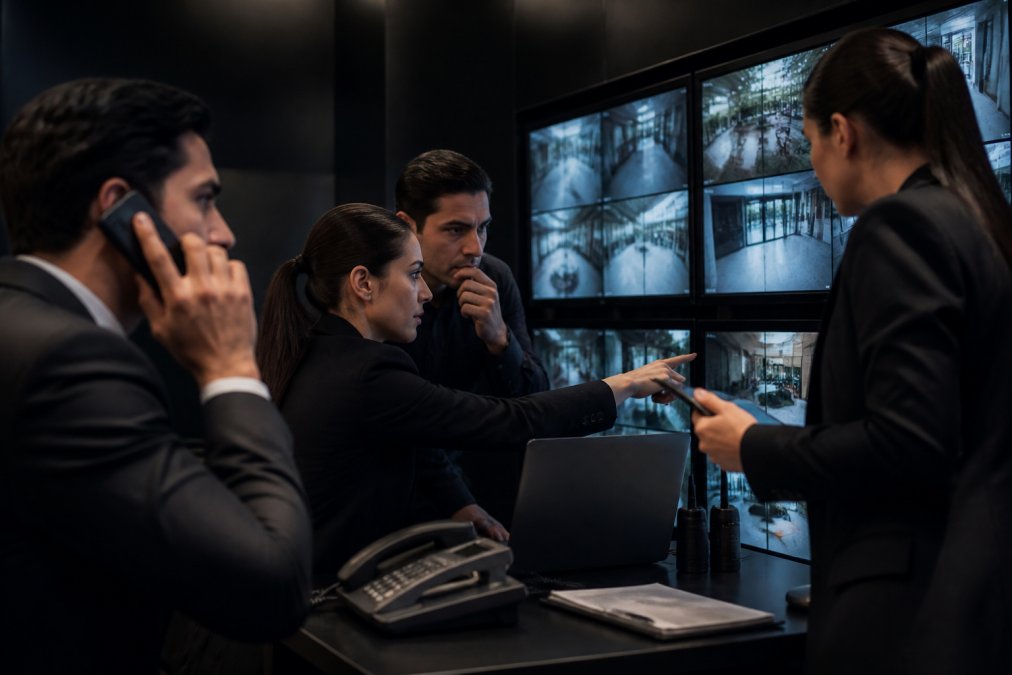
Centralized security management means one team maintains visibility into security across all properties and coordinates response to both cyber and physical incidents. Most hotel groups fail by maintaining separate teams that don't communicate until crisis forces them to.
The Unified Security Operations Center Model
Your centralized security team should include both cyber and physical security expertise, or have clear protocols for when incidents trigger cross-team responses. A ransomware attack that locks your PMS affects front desk check-ins, housekeeping room assignments, and security access log monitoring.
Establish a single incident command structure treating cyber and physical incidents as interconnected. When IT detects unusual network activity, notify physical security to review access logs and camera footage. When physical security discovers unauthorized server room access, notify cyber to determine what systems were accessed.
Implement a shared incident tracking system where both teams log, track, and escalate incidents through the same workflow.
Threat Intelligence Specific to Hospitality
Threat intelligence informs your defenses and helps prioritize security investments. Hotel groups face distinct threat profiles.
Ransomware targeting hospitality. Ransomware gangs target hotels knowing they'll pay quickly to restore systems.
Implementing Security Monitoring Across All Properties
Implement security monitoring tools aggregating logs and alerts from all properties into a single dashboard, capturing network anomalies, authentication anomalies, PMS activity, physical access logs, and unauthorized charge complaints.
Conducting Regular Security Assessments
Conduct annual security assessments across all properties. Bring in external security firms to test defenses, identify vulnerabilities, and validate incident response procedures.
Integrating Threat Intelligence into Your Incident Response Plan
Your incident response plan should reference threat intelligence findings, including specific detection signatures and response procedures for actively targeting ransomware variants.
Cyber Insurance for Hotels: Your Incident Response Backbone
Cyber insurance provides operational support during crisis, not just financial protection. Policies can include immediate access to breach response experts coordinating forensic investigation, legal counsel, and guest notification. Leveraging these professional networks effectively requires a structured approach to handling insurance claims to ensure that recovery efforts remain aligned with the broader incident response strategy.
Testing Your Plan: Incident Response Tabletop Exercises
A written incident response plan is only useful if your team can execute it under pressure. Tabletop exercises validate your plan before a real breach occurs.
Structuring a Hotel-Specific Tabletop Exercise
A tabletop exercise should follow a structured format mirroring real incident conditions, running 2-3 hours with your incident commander, corporate security lead, IT operations manager, property managers from 2-3 properties, legal counsel, and cyber insurance breach response coordinator.
Key Elements to Test in Your Tabletop
Your tabletop should specifically test communication chains under stress, guest-facing messaging, system isolation decisions, vendor coordination, and regulatory notification triggers. Your legal counsel should participate and flag language that creates liability.
Running Multiple Scenarios Across Your Portfolio
Run at least two different scenarios annually. Your first might focus on a data breach. Your second should focus on a physical security incident with cyber implications: "A guest reports unauthorized room access. Your security team discovers someone cloned keycards. Your PMS logs show they accessed guest records for 47 rooms." This tests the integration between your physical security team and your IT incident response team, a gap most hotel groups have.
Documenting and Improving Based on Results
Assign someone to document the tabletop in real time. Capture decisions made and reasoning, gaps identified, time stamps, and assumptions that proved wrong. After the exercise, hold a 30-minute debrief where participants share what surprised them and what they'd do differently. Update your incident response plan based on these findings.
Frequency and Escalation
Run a full tabletop exercise annually at minimum. For larger hotel groups with multiple properties or higher-risk profiles, consider running a smaller tabletop every six months. If your tabletop reveals significant gaps, fix them immediately and run a focused follow-up exercise to validate the fix.
Post-Incident Forensic Analysis and Recovery
After you've contained a breach and restored operations, forensic analysis begins. This is where you determine exactly what happened, what data was exposed, and how the attacker got in.
Frequently Asked Questions
What are the key components of an incident response plan for hotels?
A strong incident response plan includes detection protocols, escalation procedures, notification workflows, and recovery steps. Hotels must define roles for each property and chain-level team, establish communication chains for guest confidentiality breaches, and document handling procedures for payment card data. Your plan should also cover business continuity measures to minimize downtime and compliance reporting requirements under relevant regulations. Testing these components regularly ensures your team can execute quickly when incidents occur.
How often should hotel groups test their incident response plans?
Industry best practice is to conduct tabletop exercises at least annually, with full simulations every 18-24 months. Smaller boutique properties may start with quarterly walkthroughs of critical scenarios like ransomware or payment card breaches. After any real incident, update your plan and run a focused test within 30 days. Regular testing reveals gaps in communication, identifies training needs for frontline staff, and ensures your cyber insurance provider's response team can activate quickly when needed.
Does cyber insurance for hotels actually cover ransomware recovery costs?
Coverage varies by policy. Most cyber insurance for hotels covers incident response costs, forensic analysis, notification expenses, and regulatory fines. Some policies include ransom negotiation support, though actual ransom payments may be limited or excluded. Review your policy details carefully and discuss coverage limits with your broker before an incident occurs. A dedicated breach response team included with your cyber insurance can guide you through recovery options and help minimize total costs during an active attack.
How do I ensure compliance with data breach notification laws across multiple states?
Each state has its own data breach notification timeline and requirements. Most states require notification without unreasonable delay, but some specify 30-45 days. Your incident response plan should map notification obligations by state where you operate properties. Include templates for breach notification letters that address specific state requirements. Working with a cyber insurance provider that includes legal support helps ensure your notifications meet all state requirements and protects your hotel group from regulatory penalties.
A breach at your hotel group isn't a question of if but when. The difference between a contained incident and a catastrophic one comes down to preparation. Best Cyber Insurance for Hotels helps hotel operators develop incident response plans that actually work, then provides the 24-hour expert support needed when an incident occurs. Get started with an instant cyber insurance quote and ensure your properties are protected when it matters most.