 How-to
7 Ways to Integrate Cyber Security Into Hotel Workflows
Last Updated: November 12, 2026
Quick Summary
Integrate hotel cyber security into daily workflows by assigning every control a named department owner and workflow slot, starting with PMS access control, network segmentation, and payment data protection. Build written, rehearsed breach and ransomware response plans, then train staff through short shift-based huddles and measure time-to-report, not just click rates.
- VikingCloud's summer 2024 research found 82% of North American hotels suffered a successful cyberattack.
- Review PMS user permissions quarterly and revoke access the day an employee leaves.
- Put guest Wi-Fi on its own network segment and never let it touch the point-of-sale system.
- Name four roles in writing for breach response: incident lead, IT contact, guest communications owner, and insurance and legal contact.
- Run a 10-minute monthly security huddle per department using one scenario and one correct action.
Table of Contents
- Why Hotel Cyber Security Belongs Inside Daily Operations
- The Hotel Cybersecurity Checklist Every Department Should Own
- Step 1: Lock Down Hotel Property Management System Security
- Step 2: Segment the Hotel Network and Guest Wi-Fi
- Step 3: Verify Identity and Protect Guest Payment Data
- Step 4: Build a Hotel Data Breach Response Plan With Named Owners
- Step 5: Write a Hotel Ransomware Response Plan Before You Need It
- Step 6: Train Staff and Measure What Actually Improves
- From Checklist to Coverage
- Frequently Asked Questions
Why Hotel Cyber Security Belongs Inside Daily Operations
Hotel cyber security has become an operational discipline, not an IT afterthought. During summer 2024, VikingCloud's hotel cyberattack research found that 82% of North American hotels suffered a successful cyberattack, and 58% were hit by five or more. That is not a technology problem living in a server room.
When security sits outside daily workflows, hotels can face stolen payment data, ransom demands, and regulatory exposure that lands on the owner.
Below, we break down a seven-step workflow integration plan, who owns each step, and how to measure whether it actually works. The phases we cover move from the property management system outward, so each control builds on the last.
What the Attack Data Shows
The volume matters less than the pattern. Repeat targeting means attackers can treat hospitality as a repeatable target rather than a one-off opportunity. A single blocked phishing email does not close the gap.
The Front Desk Is the Front Line
Check-in is where identity verification, card handling, and room assignment collide in under three minutes. A rushed agent who skips a step is your largest uncontrolled risk, and no firewall compensates for it. That is why every step below assigns a named owner and a workflow slot.
The Hotel Cybersecurity Checklist Every Department Should Own
A hotel cybersecurity checklist works only when each line has a department and a person attached. Generic checklists die in a shared drive. Use this ownership map as your starting point, then adapt it to your property size.
| Control | Owner | Frequency |
|---|---|---|
| PMS access review | IT director | Quarterly |
| Guest Wi-Fi segmentation audit | IT director | Biannual |
| Card handling spot check | Front office manager | Monthly |
| Phishing simulation | GM and HR | Quarterly |
| Backup restore test | IT director | Quarterly |
| Vendor risk review | GM and procurement | Annual |
| Incident contact sheet update | GM | Quarterly |
The pattern that matters: no control belongs to "everyone."
Step 1: Lock Down Hotel Property Management System Security
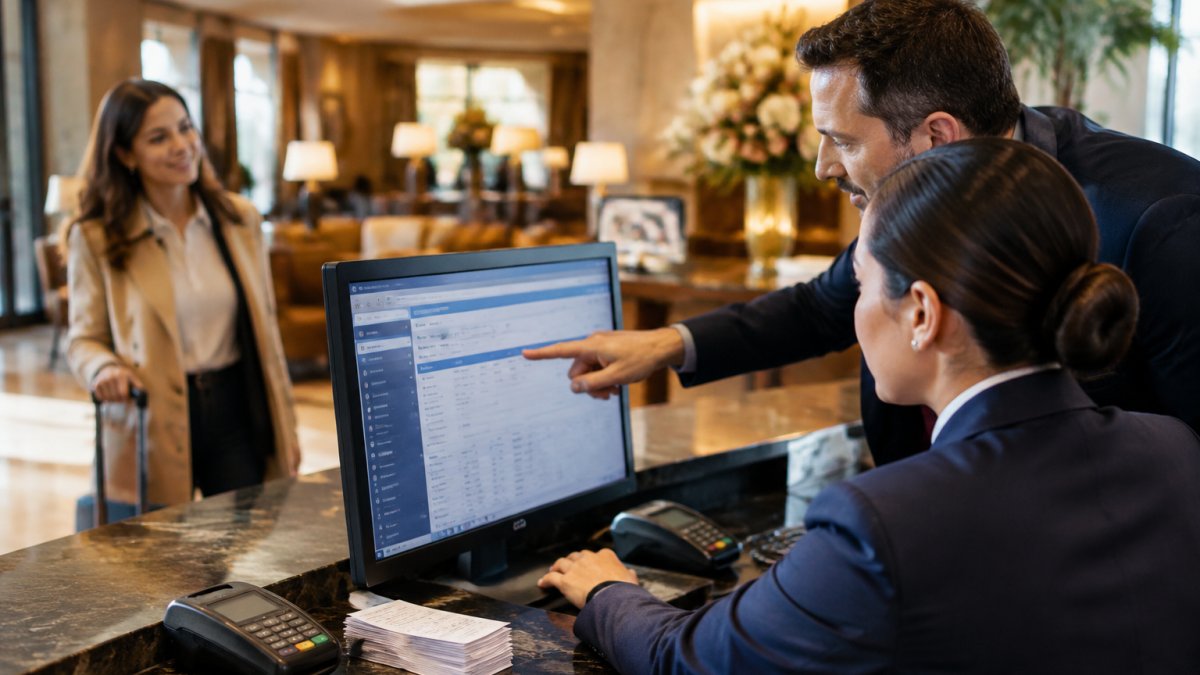
Hotel property management system security starts with access control, not antivirus. Your PMS holds guest personal information, reservation data, and often card tokens, which makes it the highest-value target on property.
Start here:
- Enforce unique logins. No shared front desk accounts, ever.
- Require multi-factor authentication for every manager-level login.
- Review user permissions quarterly and revoke access the day an employee leaves.
- Log every record export and review the log monthly.
A common mistake is leaving a departed employee's credentials active for weeks because nobody owns deprovisioning. Set a rule: the front office manager confirms termination to IT within 24 hours.
For a deeper walkthrough, read our guide on securing hotel property management systems.
Step 2: Segment the Hotel Network and Guest Wi-Fi
Segmentation is the practice of separating guest Wi-Fi, staff systems, and connected devices so a breach in one cannot reach the others.
Treat guest Wi-Fi as untrusted by default. Put it on its own network segment, isolate it from the PMS and booking system, and never let it touch the point-of-sale system. Connected devices, from smart locks to thermostats, belong on a third segment with outbound traffic restricted.
If you are planning this work, our explanation of why hotel network segmentation is critical covers the reasoning before you implement. For hands-on tactics, see securing hotel guest Wi-Fi against cyber attacks.
Step 3: Verify Identity and Protect Guest Payment Data
Payment data protection is a workflow design question. Card terminals should never store full card numbers, and staff should never write card details on paper.
Three rules close most gaps:
- Use tokenized payment terminals so the PMS never holds raw card data.
- Require photo ID verification at check-in for card-present transactions.
- Train agents to refuse phone bookings that pressure them to read back card numbers.
Watch out: shared front desk logins combined with manual card entry are the most common path to a payment breach in small properties.
Step 4: Build a Hotel Data Breach Response Plan With Named Owners
A hotel data breach response plan is a written sequence of actions with a named decision-maker for each, tested before an incident. Without names, the plan is a document nobody follows at 2 AM.
Your plan needs four roles filled in writing: incident lead, IT contact, guest communications owner, and insurance and legal contact. Include the 24-hour notification path, the evidence preservation steps, and a pre-drafted guest notice template.
A qualitative study of hotel cybersecurity at five Nevada properties found that case-study interviews surfaced gaps between policy and practice, which is exactly why named owners beat written policy alone. Assigning clear owners to security controls also makes it easier to connect everyday safeguards with insurance considerations, as Virginia Security Concepts underscores.
Best for: properties with an on-site IT lead. Skip if: you rely on a managed service provider, in which case add their escalation number to the plan and confirm response times in the contract.
Step 5: Write a Hotel Ransomware Response Plan Before You Need It
Most guides stop at "keep offline backups." That is necessary but not sufficient. The plan has to answer five operational questions before an incident, not during one.
**1.
**2.
**3.
4. Who talks to guests, and what do they say? Pre-draft two guest notices, one for a service disruption, one for a confirmed data incident, and assign the communications owner.
5. Who engages counsel, the insurer, and law enforcement? Pre-agree the call order and the dollar threshold that triggers outside counsel.
Watch out: the most common failure is a plan that assumes the PMS will come back in an hour.
Our hotel ransomware protection strategies guide covers the technical and financial trade-offs in detail.
Step 6: Train Staff and Measure What Actually Improves
Security awareness training is the process of rehearsing the specific decisions staff face on shift, then measuring whether those decisions changed.
The unique angle most guides miss: training has to fit inside the shift, not around it. A housekeeper will not sit through a 45-minute module, and a night auditor has no manager on site to coach them.
Department scenarios that actually map to the job:
- Front desk: a caller claims to be a guest's assistant and asks to read back the card on file. The correct action is to refuse, log the call, and route to the front office manager, not to "help."
- Reservations: an email from a "travel agent" asks to change a group booking's payment method. The correct action is to verify through a known phone number, never the one in the email.
- Housekeeping: a person in a vendor uniform asks for a master key to "check the router." The correct action is to call the duty manager and never hand over a key.
- Food and beverage: a POS terminal prompts for a software update during dinner service. The correct action is to refuse and report to IT, because unscheduled updates during service are a common attack vector.
- Finance: an invoice from a known vendor arrives with new bank details. The correct action is to call the vendor on a number already on file before any payment change.
- Maintenance: a smart-lock or thermostat vendor asks for remote access to "diagnose" a device. The correct action is to route the request through IT and the vendor-risk process, not to grant access directly.
Delivery mechanics that survive a real schedule:
- Run a 10-minute monthly huddle per department, led by the department head, using one scenario and one correct action.
- Pair every new hire's first week with a 15-minute security orientation before they touch the PMS.
- Send one simulated phishing email per quarter, varied by department, and debrief within 48 hours.
- Post a one-page "if this happens, do this" card at every back-of-house station.
Metrics to track, by department:
- Phishing simulation click rate and, more importantly, time-to-report. A staff member who clicks but reports within five minutes is far less costly than one who stays silent for a day.
- Training completion rate per department, reviewed monthly, not annually.
- Scenario-huddle attendance and a short post-huddle check to confirm the correct action was understood.
- Number of reported suspicious contacts per month. A rising report count is usually a sign of a healthier culture, not a worse one.
- Time from report to containment for any real incident, reviewed after every event.
Set targets that fit your property: many operators aim for a median time-to-report under 10 minutes and department training completion above 90% by the end of each quarter. Review the numbers in the same meeting where you review guest-satisfaction scores, so security stays an operational topic rather than an IT side conversation.
Watch out: the most common failure is measuring click rate alone. If click rate falls but time-to-report rises, the program is teaching staff to hide mistakes rather than report them.
For a full program structure, see our cybersecurity training guide for hotel staff.
From Checklist to Coverage
The hardest part of integrating cyber security into hotel operational workflows is not the technology. It is sustaining ownership after the first quarter, when the urgency fades and the checklist quietly stops being reviewed.
That is where coverage matters. A tested response plan still needs funding behind it when a breach happens. Best Cyber Insurance for Hotels provides specialized coverage for the hospitality industry, with an instant quote process and 24-hour access to a dedicated breach response team. If you are still scoping your exposure, an Instant Cyber Insurance Quote can show you where coverage fits before you commit.
Get started with Best Cyber Insurance for Hotels and put a funded response behind every step in your plan.
Frequently Asked Questions
How can hotels integrate cybersecurity into daily operations without slowing down check-in?
Build controls into steps staff already perform. Require multi-factor authentication at the property management system login, add identity verification to the check-in script, and route card payments through tokenized terminals so the front desk never stores card numbers. Test any new step during a slow shift first, measure added seconds per guest, and adjust before rolling it out property-wide.
What should a hotel cybersecurity checklist cover first?
Start with the assets that hold guest data: the property management system, booking engine, point-of-sale terminals, and guest Wi-Fi. A working hotel cybersecurity checklist assigns an owner to each item, sets a review date, and records evidence. Priorities include multi-factor authentication on admin accounts, network segmentation between guest and back-office traffic, patching connected devices, vendor risk reviews, and a tested backup. Review the list quarterly and after any incident, and keep it short enough that department heads actually complete it.
How much of a ransomware payment and recovery cost does cyber insurance cover?
Coverage depends on the policy you buy, so read the ransomware and business interruption sections before signing. Ask specifically whether the policy covers ransom payments where lawful, forensics, data restoration, guest notification costs, and lost room revenue during downtime. Best Cyber Insurance for Hotels offers instant quotes and 24-hour access to a dedicated breach response team, which matters when a hotel ransomware response plan is activated at 2 AM. Confirm limits and exclusions in writing rather than assuming.
Does a hotel data breach response plan need to cover state privacy laws?
Yes. Notification duties vary by state, and guests from other countries may trigger additional obligations, so your hotel data breach response plan should name counsel who can confirm which rules apply. Do not rely on a single generic timeline. Build the plan around roles instead: who isolates systems, who calls counsel, who drafts guest communications, and who handles the payment processor. Run a tabletop exercise twice a year so each owner knows their step before a real breach.