 How-to
How to Prevent Data Breaches in Hospitality: A Hotel Guide
Last Updated: November 6, 2026
Quick Summary
Preventing hospitality data breaches starts with multi-factor authentication on email, the property management system, and every admin account, then adding data encryption and network segmentation so attackers cannot move from guest Wi-Fi to payment terminals. Staff training, vendor vetting, patching, and a written breach response plan close the remaining gaps.
- Apply least privilege and role-based access control so a housekeeping supervisor cannot see payment records.
- Keep guest Wi-Fi on a separate network from the point-of-sale and property management systems.
- In the first hours of a suspected breach, isolate affected systems but do not delete or reimage them.
- Notify your insurer immediately, since most cyber policies pre-approve the forensic vendors they pay for.
- Small properties should start with free controls like MFA, network separation, and a one-page incident response plan.
Table of Contents
- Why Hospitality Data Breaches Are a Growing Threat
- Hotel Data Breach Examples That Show What Goes Wrong
- Hospitality Cybersecurity Best Practices: A Prioritized Rollout Plan
- Hotel Cybersecurity Tools That Do the Heavy Lifting
- What to Do in the First 72 Hours of a Suspected Breach
- Protecting Small and Independent Properties on a Tight Budget
- Get an Instant Cyber Insurance Quote Before the Next Attack
- Frequently Asked Questions
Why Hospitality Data Breaches Are a Growing Threat
A hotel front desk is a data goldmine. Every check-in collects a name, address, ID, and card number. Every booking system stores months of guest history.
Hotels concentrate guest information, payment card data, and personal data in systems that staff, vendors, and guests all touch daily.
Below, we break down what is at risk, what goes wrong, and the exact steps that reduce your exposure.
What Guest and Payment Data Is at Risk
Hotels hold more sensitive information than most small businesses realize. The obvious target is payment card data, but the exposure runs wider:
- Payment card data from the point-of-sale system and booking engine
- Personal data such as addresses, phone numbers, and email addresses
- Identity documents scanned at check-in, including passports and driver's licenses
The Real Cost: Financial, Legal, and Reputational Fallout
A breach does not stop at a refund. The fallout comes in four waves:
- Financial loss from chargebacks, forensic investigations, and system rebuilds
- Business disruption when the property management system goes offline during peak season
- Legal exposure from breach-notification requirements and card-brand penalties
Many properties find that the reputational hit outlasts the financial one. Guests forgive a slow elevator. They do not forgive a stolen card number.
Hotel Data Breach Examples That Show What Goes Wrong
Most hotel data breach examples follow the same pattern: a weak point everyone assumed was someone else's job. A point-of-sale system left on default credentials. A third-party vendor with broad access and no oversight.
A common mistake is treating the booking engine as separate from the front desk. In practice, they share credentials and network paths, so compromising one exposes the other.
Hospitality Cybersecurity Best Practices: A Prioritized Rollout Plan
You do not need to fix everything at once. A prioritized rollout beats a scattered checklist every time.
| Priority | Action | Effort | Why It Comes First |
|---|---|---|---|
| 1 | Turn on multi-factor authentication | Low | Blocks most credential theft |
| 2 | Encrypt data and segment the network | Medium | Limits how far an attacker moves |
| 3 | Train staff and vet vendors | Ongoing | Closes the human and supplier gaps |
| 4 | Patch and monitor systems | Ongoing | Removes known vulnerabilities |
| 5 | Build a breach response plan | Medium | Cuts downtime when an incident hits |
Step 1: Lock Down Access With MFA and Least Privilege
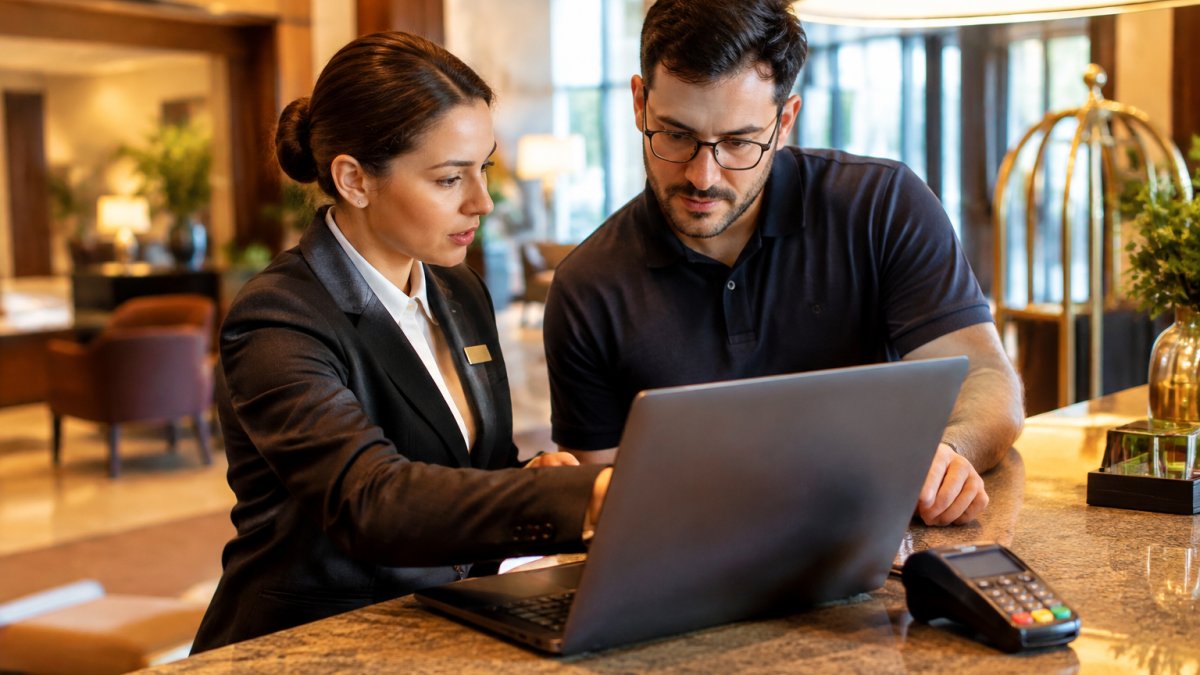
Start with identity. Require multi-factor authentication on email, the property management system, and every admin account. Then apply least privilege and role-based access control: a housekeeping supervisor should not see payment records.
Strong passwords help, but MFA does the heavy lifting. A stolen password without the second factor is far less useful to an attacker.
Step 2: Encrypt Data and Segment Your Network
Encrypt data at rest and in transit. Guest Wi-Fi must sit on a separate network from the point-of-sale system and property management system, so a compromised guest device cannot reach your payment terminals. Add a firewall and keep endpoint security current on every front-desk machine.
For a deeper look at why this matters, see our guide on why hotel network segmentation is critical.
Step 3: Train Staff and Vet Every Third-Party Vendor
Phishing and insider threat are human problems first. Run short, regular security awareness training and test it with simulated emails. Every third-party vendor and application with access to guest information needs a documented risk assessment.
Our cybersecurity training guide for hotel staff covers how to build that program, and our third-party vendor cyber risk framework shows how to score vendors before you grant access.
Hotel Cybersecurity Tools That Do the Heavy Lifting
The right hotel cybersecurity tools reduce manual work, but they do not replace process. Focus your spend on a few categories:
- Endpoint security and antivirus software on every front-desk and back-office machine
- Vulnerability management tools that flag missing security patches
- Multi-factor authentication built into your identity provider
Buy fewer tools and configure them fully. A half-configured platform is worse than none.
What to Do in the First 72 Hours of a Suspected Breach
A suspected breach is a race between your containment and the attacker's lateral movement. The first 72 hours decide whether you face a contained incident or a multi-week outage with a guest notification list. Treat this as a playbook you adapt, not a list you read for the first time at 2 AM.
Hour 0-4: Isolate and Preserve
The instinct to wipe and rebuild is wrong in the first hours. Rebuilding destroys the evidence your forensic investigator and your insurer both need.
- Isolate, do not delete. Disconnect affected systems from the network, pull the cable or disable the switch port, but leave the machines powered and intact. Do not run cleanup tools, do not reimage, and do not let a well-meaning manager "fix" the terminal.
- Preserve volatile evidence first. Memory contents and active network connections disappear on reboot. If your team has the skill, capture a memory image before powering anything down; otherwise, leave the system running but isolated.
- Activate your incident response team and notify your insurer immediately. Most cyber policies require prompt notice and pre-approve the forensic vendors they will pay for. Calling your own vendor before the insurer approves it is a common way to fund an investigation out of pocket.
- Contain the access point. Reset credentials for every account that touched the affected system, revoke third-party vendor access, and rotate any shared front-desk or property management system logins. Shared logins are the norm in hospitality and the single biggest containment obstacle.
- Preserve evidence systematically. Keep logs from the property management system, point-of-sale, door-lock system, and network gear. Export them to a separate, access-controlled location with timestamps. Chain-of-custody notes matter if the incident becomes a legal matter.
Watch out: powering down or reimaging an affected terminal to "get the front desk running again" is the most common self-inflicted wound in hospitality incidents, it can destroy the evidence needed to scope the breach and support an insurance claim.
Hour 4-24: Scope the Incident
Containment is not the same as understanding. Before you make notification decisions, you need a defensible answer to three questions: what data was exposed, whose data it was, and whether the exposure is ongoing.
- Map the blast radius. Trace which systems the compromised credentials or malware could reach. In hospitality, the booking engine, front desk, and payment terminals often share credentials and network paths, so a single compromised account can expose all three.
- Determine the data categories. Payment card data, identity documents scanned at check-in, loyalty records, and door-lock logs each trigger different obligations. Card data brings in the payment brands; identity documents and personal data bring in state law.
- Engage counsel early. Breach-notification decisions are legal decisions. Counsel also typically directs the forensic investigation so that findings can be protected where privilege applies.
Hour 24-72: Notification Decisions and Guest Communication
Notification is where hospitality breaches become public. Get the sequence right.
- Assess notification duties under state breach-notification laws. Breach-notification statutes exist at the state level, and their triggers, timing, and content requirements differ. Review the requirements of each state where you have guests, and confirm the current rules with the official state source or qualified counsel.
- Account for payment-card obligations. Your merchant agreement and the payment brands' security rules impose their own investigation and notification duties, separate from state law. Your acquirer or payment processor is a required call, not an optional one.
- Prepare guest communication with legal review before anything goes out. A clear statement of what happened, what data was involved, what you are doing, and where they can get help does more for trust than silence or vague reassurance.
A one-page playbook with named owners, after-hours contact numbers for your insurer and forensic vendor, and a pre-drafted guest-communication template is worth more than a 40-page plan nobody has read. Our hotel cyber attack response guide walks through each step in detail.
Protecting Small and Independent Properties on a Tight Budget
Small and independent properties face the same threats as chains with a fraction of the resources and no dedicated security staff. The highest-impact controls are cheap or free, and the expensive mistakes are usually about sequencing, not spending.
The Free and Near-Free Tier
Start here. These controls close most of the easy doors attackers use against small properties.
- Turn on multi-factor authentication everywhere it is offered, email, the property management system, the booking engine, and every admin account. This is the single highest-return control and usually costs nothing beyond the subscription you already have.
- Separate guest Wi-Fi from the business network. Keep the point-of-sale and property management systems off guest traffic, so a compromised guest device can never reach a payment terminal.
- Patch on a schedule. Enable automatic updates where you can and set a monthly reminder to check the rest. Unpatched systems are the most common entry point in small-property incidents.
The Modest-Budget Tier
Once the free controls are in place, these are the next dollars well spent.
- Managed detection and response for small businesses. A managed service provider can monitor endpoints and alert on suspicious activity for a predictable monthly fee, far less than hiring security staff. Ask what is monitored, the response time, and whether the provider handles containment or only alerts.
- Endpoint protection on every front-desk and back-office machine, kept current and centrally managed so a missed update does not silently leave a gap.
- Payment tokenization so card data never sits in your systems. Tokenization removes the data attackers most want and reduces your compliance scope at the same time.
Where Small Properties Get Hurt
The pattern is consistent: small properties skip the written plan because they feel too small to be a target, then discover during an incident that the insurer, forensic vendor, and payment processor all need answers nobody prepared.
Watch out: buying a stack of tools without configuring them is worse than buying fewer and configuring them fully, a half-configured platform gives false confidence and can leave logging or alerting silently disabled.
If you are choosing where to start, do the free tier first, then add managed monitoring and tokenization, then revisit the plan annually.
Get an Instant Cyber Insurance Quote Before the Next Attack
Prevention lowers your risk but does not remove it. When a breach occurs, you need a response team and a policy that covers recovery.
Best Cyber Insurance for Hotels offers specialized coverage for the hospitality industry, including protection against data breaches and coverage for ransomware and orchestrated hacks. Alongside coverage and rapid breach response, strong access controls and careful handling of guest records help protect client data before an incident occurs.
You can get an instant cyber insurance quote for your hotel and confirm your franchise requirements are met before you sign.
Frequently Asked Questions
What are the most common causes of hotel data breaches?
Phishing emails, stolen or weak credentials, unpatched software, and compromised third-party vendors cause most hospitality data breaches. Point-of-sale systems and property management systems are frequent targets because they hold payment card data and guest personal information. Insider threats and unsecured Wi-Fi networks add to the risk. A breach prevention program should address each of these paths, starting with multi-factor authentication, staff training, and vendor risk reviews.
What preventive measures can hotels take to reduce data breach risk?
Start with multi-factor authentication on every admin account and enforce role-based access control so staff only see the data they need. Encrypt payment card data at rest and in transit, segment guest Wi-Fi from the property management system, and keep security patches current. Train staff to spot phishing, vet third-party vendors, and write an incident response plan before an attack. These steps form the core of hospitality cybersecurity best practices and are affordable even for smaller properties.
How should a hotel respond to a suspected data breach?
Isolate affected systems without wiping evidence, then notify your incident response team and legal counsel immediately. Preserve logs, document what you know, and assess which guest data was exposed. Notify affected guests and regulators as required by state breach laws, and bring in your cyber insurance carrier's breach response team early. A written playbook with named contacts and a guest communication template cuts response time from days to hours.
Can cyber insurance cover a breach in our specific property management system?
Ask any cyber insurance provider to confirm in writing whether your specific property management system and payment setup are covered, and ask how quickly their breach response team can be reached. Request a quote to review the coverage terms that apply to your property.
The next attack will not wait for your busy season to end. Get started with Best Cyber Insurance for Hotels and put a dedicated response team and instant coverage behind your front desk today.